
Abigail Spanberger Makes History as Virginia's First Female Governor in Landmark Inauguration Ceremony
Former CIA officer Abigail Spanberger sworn in as Virginia's 75th governor and first female leader, alongside nation's first Muslim woman in statewide office.
U.S. POLITICS & GOVERNANCE
Sandeep Gawdiya
1/17/20267 min read
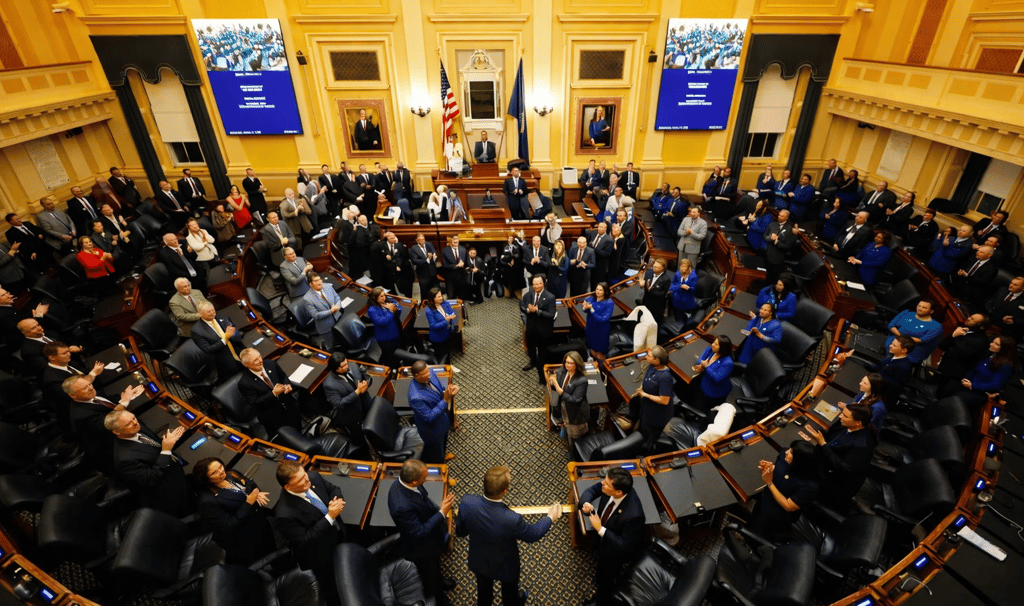
Virginia entered a transformative new chapter in its 250-year history on Saturday as Abigail Spanberger took the oath of office to become the commonwealth's 75th governor—and its first woman to hold the state's highest office. The historic midday inauguration ceremony at the state Capitol in Richmond marked not only a personal milestone for Spanberger but a watershed moment for a state whose governorship has been exclusively occupied by men since Virginia became a commonwealth in 1776.
The ceremony, characterized by traditional pageantry and grandeur in front of the Virginia state Capitol, featured a 19-gun salute by the National Guard and was followed by an inaugural parade through downtown Richmond. However, this inauguration broke with longstanding traditions in meaningful ways, as Spanberger eschewed the customary formal morning coat traditionally worn by Virginia governors, instead choosing attire that reflects her own identity as the commonwealth's first female chief executive.
A Triple Historic Victory for Virginia Democrats
Spanberger's inauguration represents the culmination of a remarkable Democratic sweep in Virginia's 2025 statewide elections, which saw the party capture all three top constitutional offices while also gaining 13 seats in the House of Delegates. The 46-year-old former CIA case officer and three-term congresswoman defeated Republican Lieutenant Governor Winsome Earle-Sears by a commanding margin of 58% to 42% in November—the largest victory for a Democratic gubernatorial candidate in Virginia since 1961.
Saturday's ceremony showcased Virginia's evolving political landscape, as two other history-making officials were sworn in alongside Spanberger. Ghazala F. Hashmi took the oath as Virginia's lieutenant governor, becoming the first Muslim woman elected to statewide office anywhere in the United States. The 61-year-old state senator, who immigrated to America from Hyderabad, India, as a young girl, defeated her Republican opponent by nearly 10 percentage points.
Jay Jones was inaugurated as Virginia's first Black attorney general, assuming office in the former capital of the Confederacy. His victory came despite controversial revelations during the campaign regarding violent text messages, which he addressed while maintaining support from party leadership and voters.
From CIA Officer to Congressional Disruptor to Governor
Spanberger's political journey has been nothing short of remarkable. A University of Virginia graduate who speaks French and served as a CIA case officer working on drug cartel cases, she entered electoral politics in 2018 amid the anti-Trump wave that brought a historic number of women to Congress. As a 39-year-old first-time candidate emphasizing pragmatism and healthcare protection, she flipped a Richmond-area congressional district that had been under Republican control for nearly fifty years.
Throughout her three terms representing Virginia's 7th Congressional District, Spanberger cultivated a reputation as a pragmatic centrist who focused on constituent services and economic issues rather than partisan warfare. This approach proved successful in a politically competitive district and laid the groundwork for her gubernatorial ambitions. Her decision to forgo reelection to Congress in 2023 to launch her gubernatorial campaign signaled her long-term strategic vision, inspired in part by then-Governor Ralph Northam's suggestion during a 2020 meeting that she should consider running for the state's top office someday.
Economic Focus and Trump Administration Resistance
Spanberger's gubernatorial campaign centered on protecting Virginia's economy from what she characterized as the aggressive and harmful policies emanating from the Trump administration in Washington. Virginia's unique position as home to hundreds of thousands of federal workers and contractors made these concerns particularly salient to voters, as Trump's Department of Government Efficiency (DOGE) implemented sweeping cuts, layoffs, and restructuring affecting federal employment.
Throughout her campaign, Spanberger spoke forcefully about the economic challenges facing Virginians, including rising costs for housing, healthcare, and energy, as well as the impact of federal tariffs and retaliatory trade policies on Virginia's businesses, farmers, and port operations. Her message resonated with voters anxious about economic stability and the erosion of the civil service workforce that forms a cornerstone of Virginia's economy.
In her victory speech in November, Spanberger emphasized that Virginia voters had chosen "pragmatism over partisanship" and "our commonwealth over chaos." She pledged to focus relentlessly on lowering costs, keeping communities safe, and strengthening the economy for every Virginian—a message aimed at both her supporters and those who voted against her.
Outgoing Governor Youngkin Hands Over Power
The Saturday ceremony marked the conclusion of Republican Governor Glenn Youngkin's four-year tenure, during which he navigated Virginia through the later stages of the pandemic recovery while pursuing conservative policy priorities including education reform and economic development initiatives. Following Virginia's constitutional prohibition on consecutive gubernatorial terms, Youngkin ceremonially handed Spanberger the key to the executive mansion, symbolizing the peaceful transfer of power.
The transition represents a significant shift in Virginia's political landscape. While Republicans control the White House and Congress in neighboring Washington, Democrats now hold unified control of Virginia's state government for the first time in recent years. This dynamic positions Spanberger to potentially serve as a prominent voice of Democratic opposition to federal policies she views as harmful to Virginia's interests.
Breaking Traditions While Honoring History
In preparing for her inauguration, Spanberger faced the challenge of respecting Virginia's deeply-rooted ceremonial traditions while also establishing her unique identity as the commonwealth's first female governor. State protocol documents, written with the assumption of male governors, required updating to reflect the historic nature of her ascension to office.
"There are no specific requirements regarding women's attire or roles," Spanberger noted when discussing the traditional inaugural dress code. While she opted not to wear the customary morning coat with coattails that male governors have traditionally donned, she emphasized her commitment to honoring Virginia's customs while modernizing them for contemporary relevance
The inauguration festivities were designed to reflect Virginia's modern diversity and vibrancy, featuring not only the traditional ceremony and parade but also a marketplace showcasing small businesses and an inaugural ball celebrating the commonwealth's cultural richness.
Honoring Virginia's Women Trailblazers
In her November victory speech, Spanberger paid tribute to the Virginia women who paved the way for her historic achievement. She specifically acknowledged Barbara Johns, a young Black activist who orchestrated a school walkout in 1951 to protest segregation—a protest that contributed to a legal case ultimately incorporated into the landmark Brown v. Board of Education Supreme Court decision that desegregated American public schools.
Spanberger also recognized Mary Sue Terry, a fellow Democrat who spent years in the Virginia House of Delegates and eight years as attorney general, becoming the first woman elected to statewide office in Virginia and demonstrating that women could successfully compete at the highest levels of Virginia politics.
"She demonstrated that regardless of age, anyone can contribute to the change and progress they wish to see in Virginia and across the country," Spanberger stated, emphasizing the importance of representation and inspiration for future generations.
Immediate Priorities and Legislative Agenda
Spanberger's transition team has been working intensively to ensure the new administration is operational from day one. The governor-elect has indicated that her immediate priorities include working with the Democratic-controlled General Assembly to advance legislation addressing economic concerns, protecting federal workers and contractors from further federal government disruptions, and responding to the ongoing impacts of Trump administration policies on Virginia.
State Democrats have committed to collaborating with Spanberger on an ambitious agenda that includes redrawing Virginia's congressional district maps ahead of the 2026 midterm elections—a contentious issue that could significantly impact the state's congressional delegation and national political dynamics. This represents a reversal for Democrats, who have historically advocated for national redistricting reform but now embrace state-level redistricting as a political necessity.
Spanberger has also signaled her intent to take executive actions on her first day in office to support Virginians facing economic challenges, demonstrating her commitment to rapid implementation of campaign promises rather than lengthy deliberation periods.
University of Virginia Leadership Controversy
In the days leading up to her inauguration, Spanberger became embroiled in a controversy regarding leadership at the University of Virginia, her alma mater. Multiple members of the university's Board of Visitors resigned less than 24 hours before her inauguration following pressure from the governor-elect regarding the selection of a new university president.
Spanberger had requested that the board postpone its presidential selection until after she took office and could appoint five new board members. She characterized the removal of former president James E. Ryan—who was pushed out by conservative alumni working with the Trump administration over diversity programs—as "federal overreach" and expressed deep concerns about the board's handling of the situation.
The episode demonstrated Spanberger's willingness to exercise gubernatorial influence over major state institutions from the outset, signaling an activist approach to executive leadership.
National Implications and Future Prospects
Spanberger's historic election and inauguration carry significance beyond Virginia's borders. As Democrats grapple with their identity following significant losses in the 2024 presidential election, Spanberger's pragmatic, economically-focused approach offers a potential model for the party's path forward—particularly in competitive purple states where ideological positioning can determine electoral success.
Her emphatic victory, achieved by the largest margin for a Virginia Democratic gubernatorial candidate in over six decades, suggests that voters respond positively to candidates who prioritize practical economic concerns over partisan positioning. This lesson may prove instructive for Democrats preparing for the 2026 midterm elections, where control of Congress will be contested.
For young women and girls throughout Virginia and beyond, Spanberger's inauguration provides tangible evidence that the highest levels of political leadership are accessible regardless of gender. "For the next generation of kids, they'll be able to see a woman in this role," Spanberger noted, emphasizing the importance of representation in shaping aspirations.
Conclusion: A New Chapter for the Commonwealth
As Abigail Spanberger raised her right hand to take the oath of office on Saturday, she became not just Virginia's 75th governor but a symbol of the commonwealth's evolving identity. The ceremony—traditional yet modernized, reverent yet forward-looking—captured the balance Spanberger seeks to strike as she leads Virginia into a new era.
With Democrats controlling state government while Republicans dominate neighboring Washington, Virginia under Spanberger's leadership may serve as a laboratory for Democratic governance and a bulwark against federal policies she views as harmful to the commonwealth's interests. The success or failure of her administration will be closely watched by political observers seeking lessons for future elections and governance strategies.
For now, Virginia celebrates a historic milestone 250 years in the making, as the commonwealth finally hears the words "Madam Governor" echoing through the halls of power in Richmond.
Updates
Delivering timely news and inspiring life stories.
Links
Contact
+917976343438
© 2025. All rights reserved.