
At Least 21 Dead, Over 100 Injured in Catastrophic High-Speed Train Collision in Spain MADRID, Spain
Emergency services in Spain are responding to one of the nation's deadliest rail disasters in recent years after a catastrophic collision between two high-speed trains left at least 21 people dead and more than 100 injured on Saturday evening. The accident occurred near the outskirts of Zaragoza, a major transportation hub in northeastern Spain, sending shockwaves through the country and raising urgent questions about railway safety protocols.
WORLD NEWS & DISASTERS
Sandeep Gawdiya
1/19/20266 min read
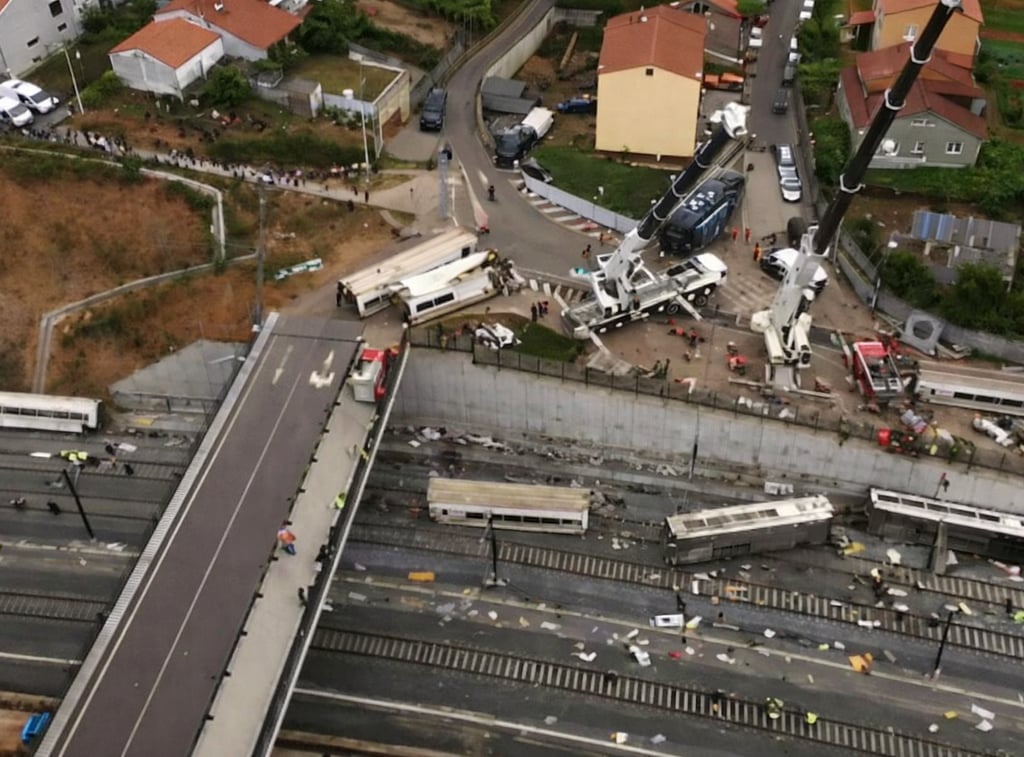
According to preliminary reports from Spanish officials, the collision took place at approximately 6:47 p.m. local time when a southbound AVE high-speed train traveling from Barcelona to Madrid collided with a northbound regional train that had apparently stalled on the same track. The impact was so severe that several carriages derailed, with at least two train cars overturning completely. Witnesses described hearing a deafening explosion followed by screams as passengers were thrown from their seats.
"It was like something out of a nightmare," said Maria Gonzalez, a passenger on the Barcelona-Madrid train who sustained minor injuries. "We were traveling at full speed when suddenly there was this tremendous crash. People were flying everywhere. The lights went out immediately, and there was smoke and dust filling the compartment. I thought we were all going to die."
Spanish Prime Minister Pedro Sánchez issued a statement from Madrid expressing his condolences to the victims' families and promising a thorough investigation into the causes of the tragedy. "This is a dark day for Spain," Sánchez said. "Our hearts go out to all those affected by this terrible accident. We will leave no stone unturned in determining exactly what happened and ensuring that those responsible are held accountable."
The death toll, which currently stands at 21, is expected to rise as rescue workers continue to search through the wreckage. Officials from the regional government of Aragon confirmed that among the dead are several children, including a 6-year-old girl and an 8-year-old boy who were traveling with their family. More than 100 people have been transported to hospitals across the region, with at least 35 listed in critical condition.
Emergency response teams from across Spain have converged on the accident site, which spans nearly half a kilometer along the railway line. Helicopters equipped with thermal imaging cameras have been deployed to search for survivors potentially trapped in the mangled wreckage. Heavy machinery is being used to carefully lift overturned carriages, while specialized rescue dogs are helping to locate victims.
Dr. Carlos Ramirez, the chief medical officer coordinating the emergency response at Zaragoza's Miguel Servet University Hospital, described the scene at his facility as "overwhelming." "We have received more than 40 patients in the past three hours," Ramirez said. "Many are suffering from severe trauma, including head injuries, broken bones, and internal bleeding. Our surgical teams are working around the clock, but the injuries are extensive."
The Spanish railway operator Renfe has launched an internal investigation while also cooperating with government authorities. Initial reports suggest that the regional train may have experienced a mechanical failure that left it stranded on the main track, but officials caution that it is too early to determine the exact cause of the collision. Questions are being raised about why the AVE train's automated safety systems did not detect the obstacle in time to prevent the crash.
Railway safety experts point out that Spain's high-speed rail network has long been considered one of the safest in the world, with sophisticated collision-avoidance technology installed on all AVE trains. The European Rail Traffic Management System, which is designed to automatically slow or stop trains when obstacles are detected, should theoretically have prevented such an accident. The fact that the collision occurred despite these systems has sparked concerns about potential system failures or human error.
"This is deeply troubling," said Dr. Heinrich Müller, a railway safety consultant based in Berlin. "Spain has invested billions of euros in state-of-the-art safety technology. If these systems failed to prevent this collision, we need to understand why immediately. There could be implications for rail networks across Europe."
The accident has drawn international attention, with condolences pouring in from world leaders. United States President Donald Trump posted on social media, stating, "Terrible tragedy in Spain. Our thoughts and prayers are with the victims and their families. The United States stands ready to provide any assistance needed." European Commission President Ursula von der Leyen also expressed her sympathy, calling the incident "a heartbreaking reminder of the importance of rail safety."
For the residents of Zaragoza and surrounding communities, the crash has created a scene of chaos and grief. Family members have been gathering at local hospitals and at a crisis center established near the accident site, desperately seeking information about their loved ones. Many have been waiting for hours, clutching photographs of missing relatives and begging officials for any news.
"My husband was on that train," said Isabella Torres, 42, her voice breaking with emotion. "He was supposed to arrive in Madrid three hours ago for a business meeting. I've been calling his phone over and over, but there's no answer. Nobody will tell me anything. I just need to know if he's alive."
The psychological toll on survivors is also becoming apparent. Counselors and mental health professionals have been deployed to assist those who witnessed the horror firsthand. Many passengers are experiencing severe shock and trauma, struggling to process what they experienced.
Transportation Minister Óscar Puente visited the crash site late Saturday evening, describing the scene as "devastating." Puente announced that all high-speed rail service between Barcelona and Madrid would be suspended indefinitely while investigators examine the track and review safety protocols. "We cannot risk another tragedy," Puente said. "Until we understand exactly what happened here, we must take every precaution."
The suspension of service has created significant disruptions for travelers across Spain. The Barcelona-Madrid route is one of the busiest in Europe, serving more than 30,000 passengers daily. Renfe has announced that it will provide alternative transportation, including buses and flights, for stranded passengers, but the logistics of accommodating so many travelers on short notice have proven challenging.
This accident marks the deadliest railway disaster in Spain since the 2013 derailment near Santiago de Compostela, which killed 79 people and injured more than 140. That crash, which occurred when a train took a curve at excessive speed, led to significant reforms in Spanish railway safety regulations and prompted Renfe to install additional safety features on its trains.
The 2013 tragedy also resulted in criminal charges against the train's driver, who was found to have been traveling at nearly twice the speed limit. While it remains unclear whether human error played a role in Saturday's collision, investigators will undoubtedly scrutinize the actions of both train operators as part of their inquiry.
Railway accidents, while relatively rare in developed countries with modern infrastructure, can have catastrophic consequences due to the high speeds and large numbers of passengers involved. The deadliest train accident in European history occurred in 1917 in France, when a troop train derailed and caught fire, killing more than 500 soldiers. More recently, a 2011 collision in Poland killed 16 people, while a 2016 crash in Italy left 23 dead.
As Spain grapples with this latest tragedy, attention is turning to broader questions about the safety of high-speed rail networks worldwide. While such systems have dramatically reduced travel times and provided environmental benefits compared to air travel, critics argue that the combination of high speeds and heavy passenger loads creates inherent risks that must be constantly managed.
Proponents of high-speed rail counter that these systems remain statistically much safer than automobile travel and that incidents like Saturday's collision, while tragic, are anomalies in an otherwise exemplary safety record. They point out that millions of passengers travel on high-speed trains in Spain, France, Japan, and China every year without incident.
Nevertheless, this accident will likely prompt renewed scrutiny of safety protocols not just in Spain but across Europe and beyond. Transportation officials in France, Germany, and Italy have already announced that they will review their own safety systems in light of the Spanish disaster. In the United States, where high-speed rail development has lagged behind Europe and Asia, advocates worry that incidents like this could further dampen public enthusiasm for such projects.
For now, the focus in Spain remains on the immediate crisis: caring for the injured, supporting the families of the deceased, and determining what went wrong. Prime Minister Sánchez has declared three days of national mourning, and flags across the country have been lowered to half-staff. A memorial service is being planned for next week to honor the victims.
As night fell on Saturday, rescue workers continued their grim task of searching through the wreckage by the light of portable generators and vehicle headlights. The twisted metal and shattered glass bore silent testimony to the violence of the collision and the fragility of human life.
"We will not rest until we have accounted for everyone," said Colonel Miguel Fuentes, the commander overseeing the rescue operation. "Every life matters. Every family deserves answers. We owe it to the victims to understand exactly what happened here and to ensure that nothing like this ever happens again."
The coming days will bring difficult questions for Spanish railway officials and government authorities. How could two trains end up on the same track? Why did safety systems fail to prevent the collision? Were there warning signs that were ignored or overlooked? The answers to these questions will be crucial not only for understanding this specific tragedy but also for preventing future disasters.
As Spain mourns and the investigation unfolds, the wreckage near Zaragoza stands as a stark reminder of how quickly tragedy can strike and how precious the safety measures that protect us truly are. For the families who lost loved ones on Saturday evening, no investigation or reform can undo their loss, but perhaps the lessons learned can help ensure that other families are spared similar grief.
The international community watches and waits as Spain confronts one of its darkest hours in recent memory, hoping that from this tragedy will emerge renewed commitment to the safety of all who travel by rail.
Updates
Delivering timely news and inspiring life stories.
Links
Contact
+917976343438
© 2025. All rights reserved.