
BJP-Led Mahayuti Sweeps Mumbai BMC Elections, Ending Uddhav Thackeray's Shiv Sena 30-Year Dynasty Over India's Richest Civic Body
BJP secures 90 seats in Mumbai's BMC elections, leading Mahayuti alliance to historic victory and toppling Shiv Sena's three-decade control of Asia's wealthiest municipal corporation.
Sandeep Gawdiya
1/16/20269 min read
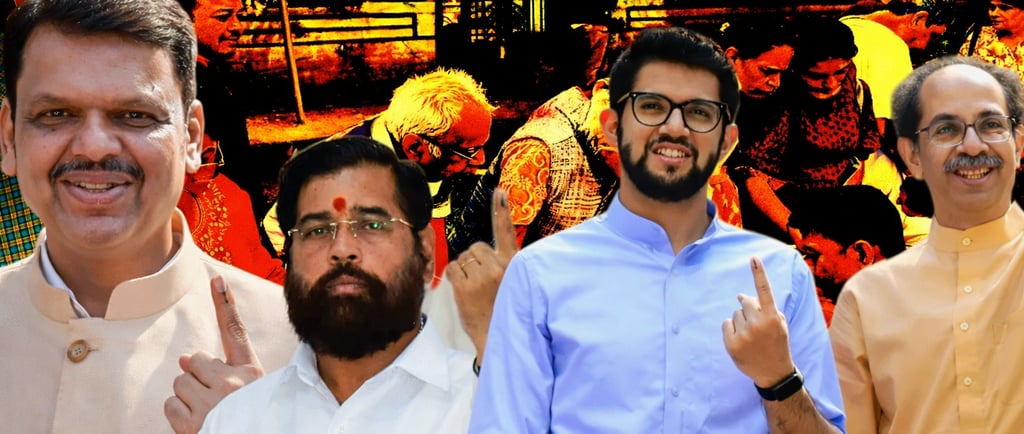
BJP-Led Mahayuti Sweeps Mumbai BMC Elections, Ending Uddhav Thackeray's Shiv Sena 30-Year Dynasty Over India's Richest Civic Body
In a seismic political earthquake that reshapes Maharashtra's power dynamics, the Bharatiya Janata Party-led Mahayuti alliance swept to a decisive victory in the Brihanmumbai Municipal Corporation (BMC) elections on Friday, January 16, 2026, ending the Thackeray family's iron-fisted control over Asia's richest civic body that had endured for nearly three decades. As vote counting concluded across 23 designated centers in Mumbai, the BJP emerged as the single largest party with 90 seats out of the 227-member corporation, while its ally—Chief Minister Eknath Shinde's Shiv Sena faction—secured 28 seats, giving the Mahayuti alliance a commanding total of 118 seats and absolute control over the municipal body that commands an annual budget exceeding several Indian states. The historic defeat marks a catastrophic collapse for Uddhav Thackeray's Shiv Sena (UBT), which managed to lead in only 58 wards despite the BMC having served as the party's primary power base and financial engine since 1985.
A Historic Political Shift: BJP Breaks Shiv Sena's Three-Decade Stranglehold
According to NDTV, Times of India, India Today, and The Week, the BMC election results represent a watershed moment in Maharashtra politics, as the BJP-led Mahayuti alliance has successfully broken the Shiv Sena's continuous control of the Brihanmumbai Municipal Corporation that began in 1985—a reign that had made the civic body synonymous with Thackeray family political dominance. The Week reported that "the erstwhile united Shiv Sena had ruled the BMC for almost three decades. The richest civic body in Asia was a milch cow for the Thackeray-run party. Now, for the first time, the BJP is likely to have its mayor to govern the affairs of the BMC, a milestone achievement."
Times of India reported that early trends from the counting, which began at 10 AM on Friday, showed the Mahayuti alliance leading in over 110 wards across Mumbai, with the BJP emerging as the overwhelmingly dominant force. According to India Today, "the Mumbai mandate turned out to be a historic one for the Mahayuti alliance as it was successful in breaking the Thackeray dominance that prevailed for almost three decades. The BJP-led Mahayuti alliance swept the polls with 118 seats, and the BJP emerged as the single largest party with 90 seats."
Prime Minister Narendra Modi responded to the victory by thanking Maharashtra voters, stating via social media posts reported by multiple outlets: "Thank you Maharashtra! The dynamic people of the state bless the NDA's agenda of pro-people good governance!" According to reports cited by CNBC-TV18, Modi added that the results indicated the NDA's bond with Maharashtra's people had "further deepened," crediting the alliance's "track record and vision for development."
BJP's Dramatic Performance: From 82 to 90 Seats
The Week and Times of India reported that the BJP's performance represents a significant improvement from its 2017 showing, when it had won 82 out of 227 seats in the BMC. According to The Week, "the BJP's performance has been excellent. It had won 82 seats out of 227 in the 2017 elections. This time, it contested 137 seats and is leading in 90 seats. The BJP leadership was hoping to touch the triple-digit mark, but that does not seem to have happened."
However, the BJP's emergence as the single largest party—a position traditionally held by the Shiv Sena—marks a fundamental power shift in Mumbai's governance. According to Times of India, Maharashtra Chief Minister Devendra Fadnavis hailed the victory, stating that "the BJP alone has won a record number of corporator seats, showing massive public backing." Fadnavis congratulated party allies and state BJP president Ravindra Chavan for their "hard work" in delivering the historic mandate.
India TV News reported that the BJP-led Mahayuti alliance appeared "poised for a decisive win" as vote counting continued across all 23 counting centers, with "elaborate arrangements in place to ensure security, traffic management and maintenance of law and order" as mandated by Election Commission of India guidelines.
Shinde's Shiv Sena: Underwhelming Performance Despite Defections
In contrast to the BJP's dominant showing, Chief Minister Eknath Shinde's Shiv Sena faction delivered a disappointing performance despite having absorbed more than 50 corporators from the original unified Shiv Sena after the 2022 party split. According to The Week, "the Shinde-led Shiv Sena contested 90 seats but is leading only in 28, despite the fact that more than 50 corporators of the united Shiv Sena had joined the Shinde faction after it was formed in 2022, and most of them were given tickets."
India Today reported that former MLA Yamini Jadhav of the Eknath Shinde-led Shiv Sena won Ward 209, defeating the Congress candidate, as one of the notable victories for the Shinde faction. However, the overall performance raised questions about whether Shinde's faction could translate its legislative strength and government backing into grassroots electoral success in Mumbai's complex political landscape.
Mid-Day reported that following the results, Deputy Chief Minister Shinde claimed his party "emerged as a winner," noting that "our party's strike rate was much better than any other political party"—a statement characterized as "a sarcastic and veiled reference to the BJP's claim of dominating Maharashtra's politics."
Uddhav Thackeray's Shiv Sena (UBT): Resilience Amid Catastrophic Loss
Despite losing control of the BMC—the crown jewel of Shiv Sena's political empire—Uddhav Thackeray's Shiv Sena (UBT) demonstrated surprising resilience, securing leads in 58 wards according to Times of India and India Today. The Week noted that "despite its defeat, Shiv Sena (UBT) has not performed all that badly, especially when compared with the Shinde-led Shiv Sena. This clearly means that Marathi voters from Mumbai still have faith and love for the Thackeray family."
However, the loss represents a devastating blow to a party for which the BMC had been both a symbol of political dominance and a critical source of patronage and financial resources. Times of India reported that the combined opposition—consisting of Shiv Sena (UBT), Raj Thackeray's Maharashtra Navnirman Sena (MNS), and Sharad Pawar's NCP (SP)—managed leads in only 68 wards total, with MNS leading in just 9 seats and NCP (SP) in barely one seat.
According to Times of India, some high-profile Shiv Sena candidates suffered defeats, including "Samadhan Sarvankar, a corporator and son of Shiv Sena legislator Sada Sarvankar" and "Deepti Vaykar, daughter of Shiv Sena MP Ravindra Vaykar." The losses underscore the challenges facing the party as it attempts to rebuild following the 2022 split that saw Eknath Shinde lead a rebellion that toppled Uddhav Thackeray's coalition government.
Congress's Dismal Performance: Relegated to Margins
The Indian National Congress delivered perhaps its worst-ever performance in Mumbai civic elections, securing leads in only 10 wards according to India Today and Times of India. India Today reported that "Congress, too, faces a grim outlook, with leads in only 10 wards," while noting that Congress candidate Asha Kale "emerged victorious over the Shiv Sena nominee in Mumbai's Lakshmi Bagh as the grand old party marked its first victory in the Brihanmumbai Municipal Corporation elections."
The Congress's marginalization in Mumbai mirrors its broader struggles in Maharashtra, where it has been unable to capitalize on anti-incumbency sentiments or effectively counter the BJP's organizational machinery and welfare schemes. Times of India reported that across Maharashtra's 29 municipal corporations, the Congress won only 31 seats in municipal council polls, far behind even smaller regional players.
Mahayuti's Statewide Sweep: Dominance Beyond Mumbai
According to Times of India and India Today, the Mahayuti alliance's victory extended far beyond Mumbai, with the BJP-Shiv Sena-NCP alliance leading in over 1,700 wards across Maharashtra's 29 municipal corporations. Times of India reported that "the alliance won or is leading in over 1,700 wards across Maharashtra," demonstrating effective vote transferability and organizational coordination despite contesting separately in some cities.
In Pune Municipal Corporation (PMC), Times of India reported that "BJP is leading in 90 out of the 165 seats," while "the Pawar-Pawar combo failed to materialise support, staying at 20 seats." The Pune results were particularly significant given Deputy Chief Minister Ajit Pawar's efforts to establish his NCP faction's credibility in his home city, where he had "targeted the local BJP leadership over the alleged irregularities in the functioning of the two civic bodies."
Times of India reported that in Nagpur Municipal Corporation, "the Mahayuti alliance has crossed the majority mark in the 151 seats," while in Thane, "the Mahayuti alliance leading in 41 seats as counting continues, with Shinde's Shiv Sena ahead in 27 seats and the BJP in 14." The statewide sweep reinforced the alliance's dominance following its decisive victory in the November 2024 Maharashtra Assembly elections.
Context: The 2022 Shiv Sena Split and Its Electoral Consequences
Times of India provided crucial context for understanding the BMC results, noting that the party split in 2022 "dealt a double blow to Uddhav Thackeray." According to the report, "not only did it bring down his MVA government and saw him lose the status of the 'real' Shiv Sena, but the real damage came in Eknath Shinde taking away a large portion of the original Shiv Sena's core strength—its ground cadre—and its traditional vote base."
The publication noted that in the 2019 assembly polls, the united Shiv Sena had won around 16% of the vote, but "five years later, the two factions together secured what would have been over 20% vote as a joint entity: 12% for the Shinde group and 10% for Uddhav." This vote division, combined with the BJP's aggressive expansion, created the electoral mathematics that enabled the Mahayuti's sweep.
Times of India characterized the BMC election as potentially decisive: "The score currently stands at 1-1: the Uddhav faction emerged ahead in the 2024 Lok Sabha polls, while the Shinde group led in the state elections just a few months later." The BMC defeat tips the balance decisively against Uddhav Thackeray, raising existential questions about his faction's future viability.
Exit Polls Accuracy and Voter Turnout Concerns
Times of India and India TV reported that exit polls had accurately predicted the Mahayuti's dominance. According to Times of India, "the Axis My India exit poll predicted the Mahayuti alliance could secure between 131 and 151 seats, while JVC projected 138 wards for it." While the final tally of 118 seats fell slightly short of these projections, the directional accuracy reinforced the exit polls' credibility.
However, Times of India noted that voter turnout raised concerns, with "overall voter turnout across the 29 municipal corporations rang[ing] between 46% and 50%, notably lower than the 2017 civic polls." Mumbai recorded approximately 50% polling compared to 55.53% in 2017. The State Election Commission attributed the decline to "voter fatigue, urban apathy and sporadic incidents during polling," though opposition parties claimed "confusion, clashes and allegations of malpractice may have discouraged voters from turning out in large numbers."
Controversies: Ink Removal Allegations and Violence
Times of India reported that the elections were marred by significant controversies, including allegations that "the indelible ink used to mark voters' fingers could be easily removed using sanitizers or nail polish remover." The claims raised concerns about possible double voting, prompting the State Election Commission to order "a detailed probe into the quality and application of the ink."
Additionally, Times of India noted that "polling day witnessed sporadic clashes between rival groups in several cities, along with allegations of bogus voting, cash distribution and voter intimidation." While the SEC maintained the overall process remained largely peaceful, opposition parties alleged serious lapses in poll management and demanded accountability.
What This Means: BJP's Path to Mumbai Mayor
With the Mahayuti alliance securing 118 of 227 seats, the BJP is positioned to install Mumbai's first BJP mayor in the BMC's modern history. The Week noted this would be "a milestone achievement by Fadnavis and Mumbai BJP president Amit Satam," fundamentally altering the power dynamics in India's financial capital.
Control of the BMC—which manages an annual budget exceeding ₹45,000 crore (approximately $5.4 billion) and oversees civic services for over 12 million Mumbai residents—provides the BJP with enormous patronage opportunities, contracting authority, and policy influence in India's most economically significant city. The BMC controls everything from infrastructure development and slum rehabilitation to municipal schools and healthcare facilities, making it one of Asia's most powerful local government bodies.
For Uddhav Thackeray's Shiv Sena (UBT), the loss represents not merely an electoral defeat but potentially the end of an era. The BMC had been the foundation of Shiv Sena's political and financial strength since 1985, providing resources, visibility, and patronage networks that sustained the party through various political cycles. Its loss leaves the Uddhav faction without its most critical institutional base as it struggles to differentiate itself from Shinde's government-backed rival faction.
The results also validate the BJP's strategy of aggressive expansion in urban Maharashtra under Fadnavis's leadership, demonstrating that the party can win decisively even in Mumbai's complex multi-ethnic, multi-linguistic political landscape—a city where Marathi sub-nationalism and Shiv Sena's "sons of the soil" rhetoric had historically proven electorally potent.
As Maharashtra's political landscape continues to realign following the 2022 Shiv Sena split, the BMC results suggest the BJP-led Mahayuti's dominance may prove durable, with implications extending far beyond municipal governance to shape the state's political trajectory for years to come.
Updates
Delivering timely news and inspiring life stories.
Links
Contact
+917976343438
© 2025. All rights reserved.