
Canada and China Forge Historic Strategic Partnership as Carney Meets Xi, Announcing Tariff Relief and $3 Billion Export Boost
Canadian PM Mark Carney and Chinese President Xi Jinping announce landmark trade agreement with tariff reductions and 50% export growth target amid US tensions.
INTERNATIONAL RELATIONS & TRADE DIPLOMACY
Sandeep Gawdiya
1/16/20267 min read
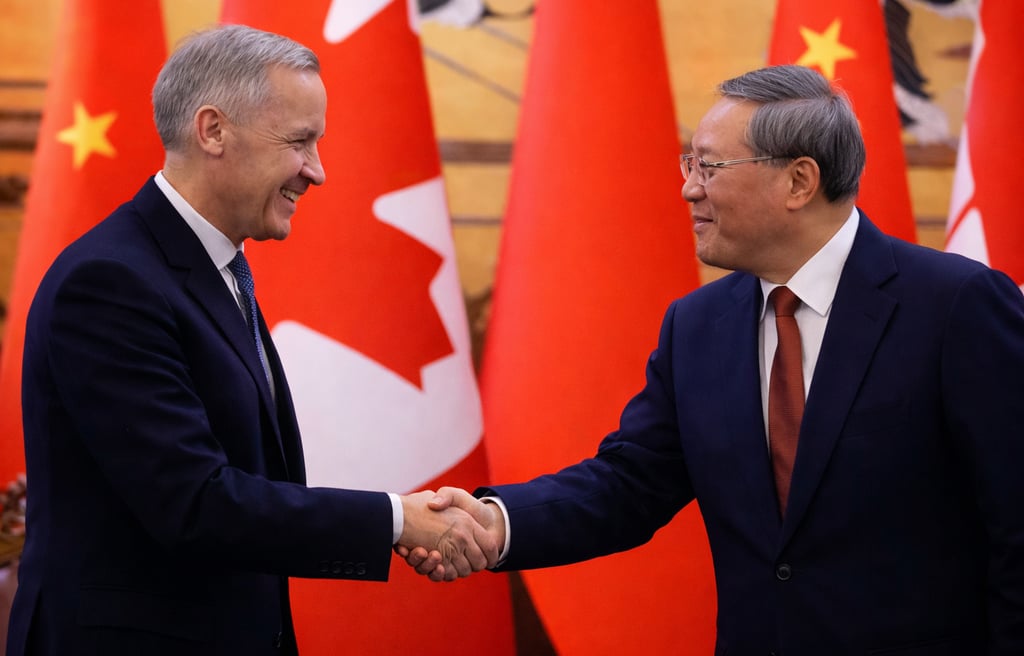
Canada and China Forge Historic Strategic Partnership as Carney Meets Xi, Announcing Tariff Relief and $3 Billion Export Boost
First Canadian prime ministerial visit to Beijing in nearly decade yields breakthrough trade agreement as Ottawa diversifies away from unpredictable US relationship
BEIJING — Canadian Prime Minister Mark Carney and Chinese President Xi Jinping announced Friday a comprehensive strategic partnership agreement featuring significant tariff reductions and commitments to increase bilateral trade by 50 percent by 2030, marking what Xi characterized as a "turnaround" in relations between the two nations after years of deep acrimony and reciprocal trade barriers.
The breakthrough came during Carney's official visit to Beijing from January 14-17, representing the first trip to China by a Canadian prime minister since 2017 and signaling a dramatic reset in bilateral relations as Canada seeks to reduce economic dependence on the United States amid escalating tensions with President Donald Trump's administration.
Meeting in Beijing's Great Hall of the People, Carney told Xi that their "new strategic partnership" represents an opportunity to enhance a strained global order by building upon past relationship strengths to forge arrangements reflecting current global conditions, with mutual interests in agriculture and energy sectors offering potential for "historic advancements".
Landmark Trade Agreement Unlocks Billions in Export Orders
The centerpiece of the agreement includes preliminary measures to remove trade barriers and reduce tariffs that Canadian officials estimate will unlock nearly $3 billion in export orders for Canadian workers and businesses as they realize full potential of China's massive 1.4 billion-person market.
By March 1, 2026, Canada expects resolution of numerous long-term trade obstacles affecting critical agricultural sectors including beef, pork, canola, pet food, and other products that have faced Chinese import restrictions or prohibitive tariffs in recent years. The agreement establishes an Economic Partnership Working Group scheduled to convene in person in Canada during summer or fall 2026 to facilitate ongoing cooperation.
Chinese tariffs on Canadian agricultural products, including a 100 percent levy on most canola oil products that significantly impacted Saskatchewan's vital canola industry, are expected to be substantially reduced or eliminated under the new framework. These punitive measures were imposed in 2024 after Canada, aligning with United States policy, levied 100 percent tariffs on Chinese electric vehicles.
The trade cooperation roadmap commits both nations to holding regularized engagement to facilitate positive momentum and manage challenges effectively, acknowledging that trade issues are a normal component of complex trading relationships.
Strategic Pivot Amid Deteriorating US-Canada Relations
Carney's Beijing visit occurs against a backdrop of profoundly strained Canada-United States relations, with President Trump having largely abandoned trade discussions with Ottawa and repeatedly threatening Canadian sovereignty through rhetoric suggesting potential annexation. Trump's "America First" policies and unpredictable tariff impositions have adversely affected both Canadian and Chinese economies, creating common ground for the two nations to strengthen bilateral ties.
Prior to his visit, Carney stated his government aims to cultivate an economy less dependent on the United States during "a time of global trade disruption," meeting with executives from prominent Chinese firms including electric vehicle battery manufacturers and energy conglomerates to identify investment opportunities. The diplomatic repositioning represents a fundamental shift for Canada, which has historically aligned closely with Washington regarding China policy.
Under pressure from a resistant President Trump and facing steep retaliatory tariffs on vital Canadian exports, Carney is investing considerable effort to find new markets for Canadian products, with China serving as his primary focus given its status as Canada's second-largest export market after the United States.
Energy and Clean Technology Cooperation Central to Partnership
Central to the new strategic partnership is an agreement to collaborate in energy, clean technology, and climate competitiveness sectors. Canadian and Chinese officials characterized both nations as "energy superpowers" focused on expanding two-way energy cooperation while reducing emissions and scaling up investments in batteries, solar panels, wind turbines, and energy storage systems.
The cooperation framework commits both sides to supporting two-way investments and trade in clean and conventional energy, with Canada welcoming Chinese investments in energy, agriculture, consumer products, and other sectors while both nations pledge to improve transparency for foreign investments in accordance with domestic legal frameworks.
During his Beijing visit, Carney engaged directly with business leaders in energy and clean technology sectors to identify and accelerate Chinese investment opportunities in Canada, seeking to position Canadian industries to benefit from China's massive domestic market and manufacturing capabilities.
Both nations formalized several memorandums of understanding Thursday reinforcing cooperation on energy, combating transnational crime, cultural exchanges, wood products trade, and food safety and animal and plant health standards.
Ambitious Export Growth Targets and Multilateral Cooperation
Canadian and Chinese leaders established an ambitious goal to increase Canadian exports to China by 50 percent by 2030, building on the existing foundation where agri-food and general trade have historically underpinned bilateral relations. To achieve this outcome, both sides discussed increasing two-way investment across clean energy and technology, agri-food products, wood products, and diverse other sectors.
The agreement includes commitments to establishing a financial working group to enhance bilateral engagement on financial and monetary policies, financial markets, financial stability and regulation, anti-money laundering measures, cross-border capital flows, and global financial governance. This group will report to co-chairs of the Economic and Financial Strategic Dialogue and aims to hold frequent professional exchanges on shared interests.
Both nations reaffirmed support for the rules-based multilateral trading system with the World Trade Organization at its core, committing to collaborate on areas of shared interest aiming to achieve practical outcomes in WTO reform at the 14th Ministerial Conference scheduled for March 2026. Canada and China also committed to working together through the Asia-Pacific Economic Cooperation forum to advance mutual objectives including strengthening trade and investment, promoting innovation, and fostering sustainable and inclusive growth.
Canada expressed support for China's hosting of the 2026 APEC meetings and looks forward to a successful APEC year, while appreciating China's support for Canada's bid to host the summit in 2029.[pm.gc]
Balancing Economic Interests with Human Rights Concerns
Carney emphasized during discussions with Xi that Ottawa does not concur with Beijing on all issues, clearly stating Canada's "red lines" including human rights concerns, worries regarding election interference, and the necessity for "guardrails" in the bilateral relationship. This acknowledgment reflects Canadian domestic political sensitivities regarding deepened engagement with China given longstanding tensions over human rights issues, Beijing's treatment of Uyghur minorities, and allegations of Chinese interference in Canadian elections.
The visit represents what analysts describe as a "reset of a relationship" that may be "modest in ambition" yet "much more realistic about what we can reasonably achieve," according to Charles Robertson, former Canadian diplomat and vice president at the Canadian Global Affairs Institute. This pragmatic approach acknowledges fundamental differences between the two nations' political systems and values while seeking economic cooperation in areas of mutual benefit.
Foreign Affairs Minister Anita Anand previously characterized the approach as seeking balance between alleviating economic stress on Canadian industries and pursuing Ottawa's security and human rights priorities.
Historical Context and Path to Reconciliation
Canada-China relations deteriorated sharply in recent years following a series of disputes beginning with Canada's 2018 arrest of Huawei executive Meng Wanzhou at Vancouver airport on a United States extradition request, prompting Beijing to detain two Canadian citizens in apparent retaliation. The "two Michaels" case—involving Canadian diplomat Michael Kovrig and businessman Michael Spavor—strained bilateral relations for nearly three years until their release in 2021 coinciding with Meng's return to China.
Additional tensions emerged over Canadian allegations of Chinese interference in federal elections, human rights concerns regarding Beijing's treatment of Uyghurs and Hong Kong residents, and broader strategic competition in the Indo-Pacific region where Canada has aligned with United States and allied positions often contrary to Chinese interests.
The reconciliation process began in October 2025 when Carney and Xi held their first direct dialogue during a 40-minute meeting on the sidelines of an Asia-Pacific Economic Cooperation summit in South Korea. Xi expressed readiness to further develop the relationship, noting that their meeting "opened a new chapter in China-Canada relations moving forward". The leaders instructed their respective teams to act swiftly to address lingering trade issues and concerns, setting the stage for this week's comprehensive breakthrough.
Implications for Regional Trade Architecture
Analysts suggest Carney's visit could serve as a model for other nations grappling with repercussions of President Trump's unpredictable tariff policies and broader "America First" economic nationalism. As Xi strives to portray China as a reliable global partner advocating for pragmatic relations characterized as "win-win" scenarios, the Canada-China agreement may encourage other traditional United States allies to diversify economic partnerships and reduce dependence on American markets.
Canada reiterated that the Comprehensive and Progressive Agreement for Trans-Pacific Partnership remains open to accession by economies satisfying the Auckland Principles, implicitly leaving the door open to potential future Chinese membership in the massive Pacific Rim trade bloc despite current member reservations. China has expressed continued interest in joining CPTPP, though the pathway remains complicated given concerns among existing members about Beijing's adherence to the agreement's high standards.
The agreement commits both sides to resuming the Intellectual Property Working Group and pursuing discussions toward consensus on terms of reference that could result in resumption of the Trade Remedies Working Group, addressing longstanding Canadian concerns about Chinese trade practices while providing frameworks for managing future disputes.
Domestic Political Dimensions
For Carney, who became prime minister following Justin Trudeau's departure, the Beijing breakthrough represents a significant early foreign policy success demonstrating his government's commitment to diversifying Canadian trade relationships and asserting greater economic independence from the United States. The agreement's emphasis on unlocking $3 billion in export opportunities provides tangible economic benefits Carney can present to domestic constituencies, particularly agricultural producers in Western Canada who have suffered under Chinese tariffs in recent years.
However, the closer embrace of China also carries domestic political risks given persistent Canadian public concerns about human rights issues, national security implications of Chinese investment in sensitive sectors, and allegations of Beijing's interference in Canadian democratic processes. Carney's explicit articulation of Canadian "red lines" during discussions with Xi appears calculated to address these sensitivities while pursuing economic cooperation.
Looking Forward
The coming months will test whether the ambitious framework announced Friday translates into concrete economic benefits and sustainable improvement in bilateral relations. The March 1 deadline for initial tariff reductions will serve as an early indicator of both sides' commitment to implementation. The scheduled summer/fall 2026 Economic Partnership Working Group meeting in Canada will provide additional opportunity to assess progress and address emerging challenges.
As geopolitical tensions persist between Western democracies and China over issues ranging from technology competition to regional security, Canada's pragmatic engagement approach reflects a calculation that economic diversification and reduced dependence on the United States outweigh risks associated with deeper Chinese partnership, at least in carefully defined sectors where cooperation serves mutual interests without compromising core Canadian values and security concerns.
Updates
Delivering timely news and inspiring life stories.
Links
Contact
+917976343438
© 2025. All rights reserved.