
European Troops Deploy to Greenland as Trump Threats Escalate After US-Denmark Talks Hit 'Fundamental Disagreement' Wall
France, Germany, Norway and Sweden send military personnel to Arctic island as Denmark boosts security amid Trump's annexation threats and failed negotiations.
GEOPOLITICS & INTERNATIONAL SECURITY
Sandeep Gawdiya
1/16/20266 min read
European Troops Deploy to Greenland as Trump Threats Escalate After US-Denmark Talks Hit 'Fundamental Disagreement' Wall
NATO allies dispatch soldiers to Arctic territory in show of solidarity with Denmark as Washington negotiations fail to resolve sovereignty dispute over strategically vital island
NUUK, GREENLAND — Troops from France, Germany, Norway, and Sweden have begun arriving in Greenland to help bolster the Arctic island's security following high-level negotiations between Denmark, Greenland, and the United States that exposed a "fundamental disagreement" between President Donald Trump's administration and European allies over the territory's future.
The deployments commenced Thursday, the same day foreign ministers of Denmark and Greenland met with US Vice President JD Vance and Secretary of State Marco Rubio in Washington, where talks produced what Danish Foreign Minister Lars Løkke Rasmussen characterized as productive discussions marred by persistent, irreconcilable differences over Trump's demands for American control of the semi-autonomous Danish territory.
"While the discussions were productive, a 'fundamental disagreement' persisted between the two parties," Rasmussen stated following Wednesday's meeting, directly criticizing Trump's attempts to purchase Greenland. The deployment of European military personnel represents a tangible demonstration that NATO allies will not acquiesce to American territorial ambitions that violate Danish sovereignty.
Scale and Composition of European Military Response
France dispatched an initial contingent of 15 soldiers to Greenland's capital Nuuk, with President Emmanuel Macron announcing on social media that "the first military elements are already en route. Others will follow". Germany contributed a reconnaissance team of 13 personnel who first deployed to Copenhagen before proceeding to Greenland with Danish forces aboard an Airbus A400M transport aircraft.
Late Wednesday, footage showed a Danish Air Force plane landing at Nuuk airport with military personnel in combat fatigues disembarking for joint exercises. Norway and Sweden are also participating in the expanded military presence, though specific troop numbers for these nations have not been publicly disclosed.
On Thursday, uniformed soldiers could be seen strolling the quiet streets of Nuuk, appearing not to trouble local residents who have reacted with a mixture of anxiety and relief that negotiations with Washington would continue despite the impasse. The soldiers' visible presence in the capital of 19,000 inhabitants sends an unmistakable political message about European resolve to defend a NATO member's territorial integrity.
The Danish Ministry of Defence stated that "the Danish Armed Forces, alongside several Arctic and European partners, will investigate in the upcoming weeks how to implement an increased presence and exercise activity in the Arctic". While the full scale of planned military escalation remains undisclosed, initial deployments appear deliberately modest, designed to signal solidarity without unnecessarily provoking Washington.
Denmark's Strategic Response and Long-Term Military Commitment
Danish Defense Minister Troels Lund Poulsen indicated Thursday that the intention is "to establish a more permanent military presence with a larger Danish contribution," with soldiers from several NATO countries to be stationed in Greenland on a rotation system. The rotating deployment model allows European allies to maintain sustained military presence without requiring prohibitively large permanent garrisons in the harsh Arctic environment.
Copenhagen has begun challenging Trump's stated rationale for seeking control over Greenland. Rasmussen noted there is no "immediate" threat from China or Russia that Denmark cannot manage independently, though he acknowledged some alignment with broader American security concerns about Arctic competition. This calibrated response acknowledges legitimate strategic interests while firmly rejecting territorial designs.
French Ambassador to the Poles Olivier Poivre d'Arvor told France Info radio: "We will demonstrate to the United States that NATO is present, that Denmark has significantly enhanced its surveillance capabilities in Greenland, that the [European] Union is here to ensure the overall national security of the region". The statement underscores European determination to frame Greenland's security as a collective NATO responsibility rather than an exclusively American prerogative.
Danish Foreign Minister Rasmussen revealed that approximately 200 US troops are currently stationed in Greenland, which has a population of around 57,000, primarily at Pituffik Space Base (formerly Thule Air Force Base), a crucial early warning radar installation monitoring potential missile launches over the Arctic. The limited American military footprint belies the strategic importance Trump ascribes to the territory.
Failed Washington Negotiations and Diplomatic Impasse
The European troop deployments followed Wednesday's Washington meeting between Danish and Greenlandic officials and senior Trump administration figures that failed to resolve fundamental disagreements over Greenland's status. The talks exposed unbridgeable differences between Trump's declared intention to acquire Greenland "one way or another" and Danish-Greenlandic insistence on sovereignty and self-determination.
Trump has repeatedly stated he will take action on Greenland "whether its people like it or not," threatening to use military force, economic coercion, or other unspecified means to bring the Arctic island under American control. His administration argues that Greenland is vital to US national security given its strategic location between North America and Europe, its proximity to major shipping routes opened by Arctic ice melt, and vast mineral deposits including rare earth elements critical to advanced technology.
During the Washington talks, US officials emphasized security concerns and the need for enhanced American presence to counter Russian and Chinese activities in the Arctic region. However, Danish and Greenlandic representatives firmly rejected any suggestion that sovereignty could be negotiated, while remaining open to discussions about expanded security cooperation within existing frameworks respecting Greenland's autonomy.
The diplomatic impasse prompted Denmark to accelerate European military involvement as a visible demonstration that Greenland's security does not require American sovereignty and that NATO allies will support Danish territorial integrity against even allied pressure.
Trump's Special Envoy and Parallel Diplomatic Track
As negotiations stalled in Washington, Trump appointed Louisiana Governor Jeff Landry as special envoy to Greenland, creating a parallel diplomatic channel that Greenland's government has cautiously welcomed despite skepticism about Trump's ultimate intentions. Landry reportedly seeks a more diplomatic approach than Trump's public pronouncements suggest, though how much latitude the president will grant his envoy remains unclear.
The appointment of a special envoy separate from the failed Washington talks indicates the Trump administration recognizes that its confrontational approach has failed to yield progress while galvanizing European opposition. However, Trump has shown no willingness to abandon his Greenland ambitions or moderate his threatening rhetoric.
US Senators, primarily Democrats, have traveled to Copenhagen separately to push back against Trump's threats and demonstrate congressional opposition to any forced acquisition attempt. The bipartisan congressional delegation's presence underscores that Trump's Greenland obsession faces significant domestic political obstacles beyond international opposition.
Strategic Importance and Geopolitical Context
Greenland's strategic significance has grown dramatically in recent decades as climate change opens Arctic shipping lanes and makes previously inaccessible mineral deposits exploitable. The island sits astride potential transpolar routes that could dramatically reduce shipping times between Europe and Asia, while also hosting critical early warning systems that provide indispensable missile defense coverage for North America.
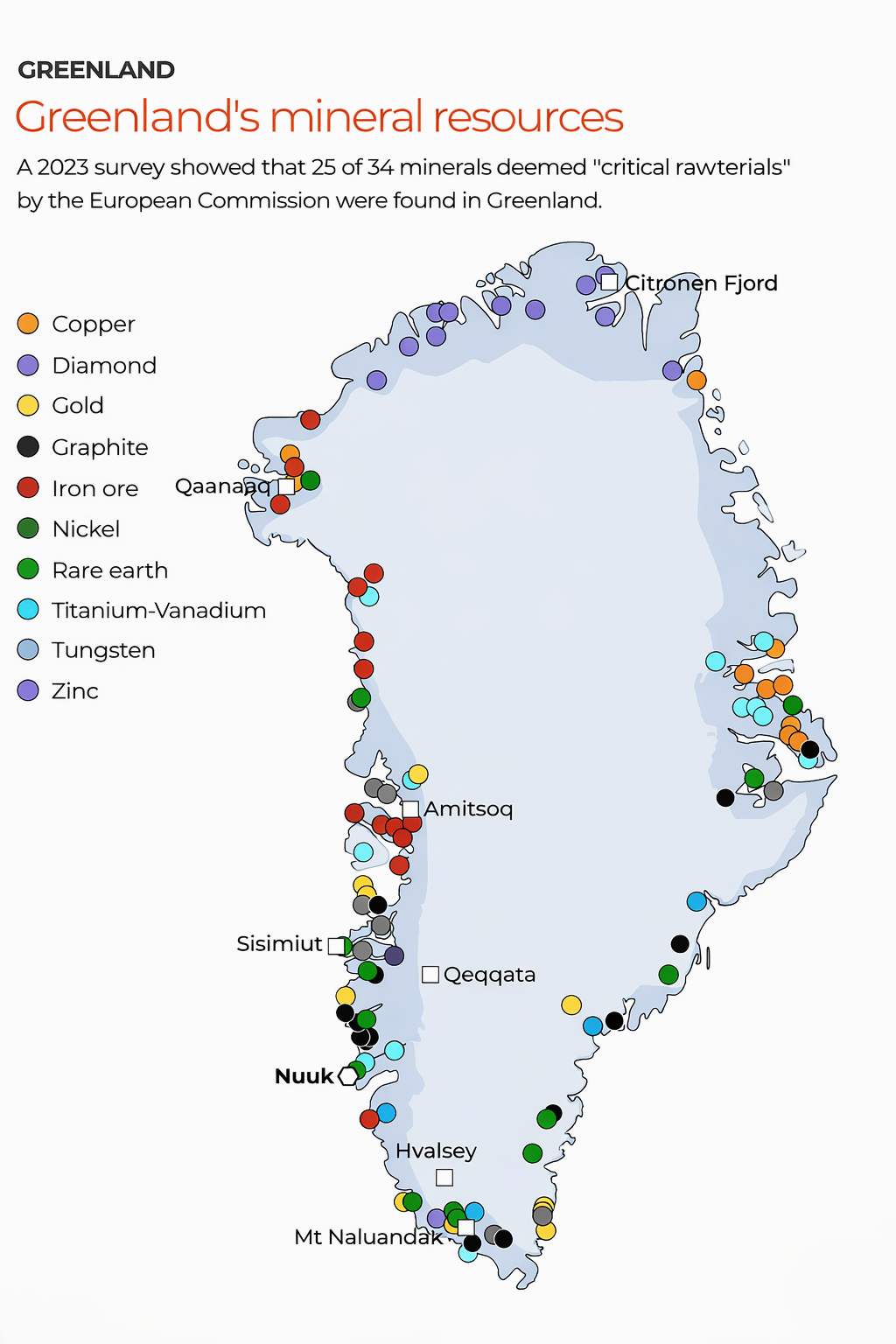
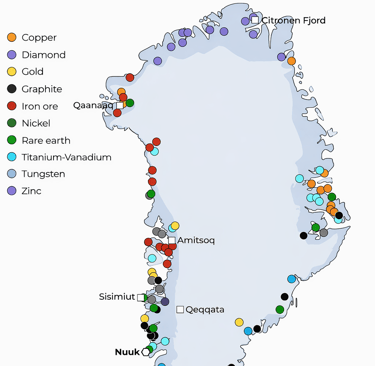
Beyond location, Greenland possesses substantial deposits of rare earth elements essential for electronics, advanced weaponry, renewable energy systems, and other cutting-edge technologies in which the United States seeks to reduce dependence on Chinese supply chains. Trump has framed potential acquisition as securing these strategic resources for American use.
China has shown increasing interest in Greenland's resources and infrastructure development opportunities, attempting to finance airport construction projects that Denmark ultimately blocked due to security concerns. Russia maintains an extensive Arctic military presence and has expanded operations as ice retreat makes northern territories more accessible. These great power competition dynamics form the legitimate security context Trump invokes to justify his Greenland demands.
However, European allies argue that existing NATO arrangements, Danish sovereignty, and Greenlandic autonomy adequately address security requirements without requiring territorial transfer. The European military deployment demonstrates this alternative vision—enhanced collective defense respecting sovereignty rather than unilateral American control.
Local Reactions and Self-Determination Questions
Inhabitants of Greenland and Denmark have reacted to the escalating tensions with anxiety mixed with relief that negotiations continue and European support has become tangibly visible. Greenland's population overwhelmingly opposes becoming American territory, though some residents express openness to enhanced economic cooperation if it respects self-determination.
Greenland achieved home rule from Denmark in 1979 and expanded autonomy in 2009, gaining control over most domestic affairs while Denmark retains responsibility for foreign policy and defense. Many Greenlanders aspire to eventual full independence, viewing American acquisition as exchanging one colonial relationship for another rather than achieving genuine sovereignty.
Greenlandic leaders have walked a diplomatic tightrope, welcoming potential American investment and enhanced security cooperation while firmly rejecting sovereignty transfer. This position seeks to extract maximum benefit from great power competition while preserving autonomy and the pathway toward eventual independence.
Broader Implications for NATO and Transatlantic Relations
Trump's Greenland threats represent an unprecedented strain on NATO solidarity, forcing European allies to contemplate defending a member state's territory against pressure from the alliance's most powerful member and security guarantor. The paradox of NATO allies deploying troops to protect against implied American threats challenges fundamental assumptions about the alliance's purpose and cohesion.
European officials have sought to frame their response as reinforcing NATO collective defense principles rather than confronting Washington directly. However, the reality that European troops in Greenland serve to deter American territorial ambitions as much as Russian or Chinese threats fundamentally alters traditional alliance dynamics.
French President Macron and other European leaders have used the Greenland crisis to advance arguments for greater European strategic autonomy and reduced dependence on American security guarantees that could be withdrawn or weaponized for political purposes. The episode vindicates long-standing French concerns about excessive reliance on Washington for continental security.
For Denmark, the crisis has transformed from abstract concern about American reliability into immediate need for European military support to reinforce sovereignty against an allied power. The success of Denmark's appeal for European assistance demonstrates that even smaller NATO members can leverage collective defense mechanisms to resist pressure from Washington when clearly in the right on matters of territorial integrity.
As European soldiers settle into Greenland for what appears to be an extended deployment, the Arctic island has become an unlikely frontline in debates about sovereignty, alliance obligations, great power competition, and the future of the transatlantic security architecture. The standoff shows no signs of imminent resolution, with Trump reportedly undeterred by European opposition and Danish-Greenlandic officials equally determined to resist territorial concessions regardless of American pressure.
Updates
Delivering timely news and inspiring life stories.
Links
Contact
+917976343438
© 2025. All rights reserved.