
FIFA World Cup 2026 Shatters Records with Over 500 Million Ticket Requests as Colombia-Portugal Miami Match Tops Demand
Historic 48-team tournament sees unprecedented global demand with 15 million daily ticket requests; only 4-5 million seats available for 104 matches.
SPORTS & GLOBAL EVENTS
Sandeep Gawdiya
1/16/20267 min read

FIFA World Cup 2026 Shatters Records with Over 500 Million Ticket Requests as Colombia-Portugal Miami Match Tops Demand
Unprecedented global enthusiasm sees fans submit half-billion applications during 33-day window, indicating interest in over one billion tickets for expanded tournament
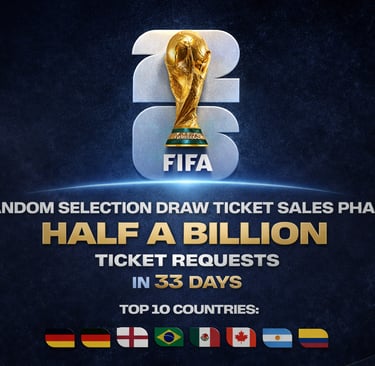
ZURICH/MIAMI — FIFA announced Wednesday that it received more than 500 million ticket requests for the 2026 World Cup during a 33-day Random Selection Draw application period that closed Tuesday, setting a new benchmark for demand in the history of global sport and creating a ticket lottery of unprecedented proportions for the first-ever 48-team tournament.
With each application validated by unique credit card data, fans placed an average of 15 million ticket requests per day over the application window that ran from December 11, 2025, through January 13, 2026. The staggering figure—likely indicating interest for more than one billion total tickets since each request can include one to four seats—vastly exceeds the approximately 4 to 5 million tickets FIFA estimates remain available for the tournament after selling around 2 million during pre-sale events last October and November.
"Receiving half a billion ticket requests in just a month is not just a reflection of demand, but a global declaration," FIFA President Gianni Infantino stated in response to the historic figures. The oversubscription suggests the 104-match tournament, jointly hosted by the United States, Mexico, and Canada from June 11 to July 19, 2026, will be dramatically oversubscribed overall, with random selection draws determining who secures actual seats.
Colombia-Portugal Miami Clash Emerges as Most Coveted Match
The most requested fixture during the sales phase is Colombia versus Portugal scheduled for Saturday, June 27, at Hard Rock Stadium in Miami Gardens, Florida—a matchup that perfectly captures the tournament's appeal to diverse fan bases across the Americas. The South Florida location, home to vibrant Colombian and Portuguese-speaking communities, combined with star power from both nations makes the group stage encounter a celebration of the region's rich Latin American and European soccer connections.
The top five most-requested matches also included Mexico versus Korea Republic in Guadalajara on Thursday, June 18; the final at MetLife Stadium in East Rutherford, New Jersey, on Sunday, July 19; the tournament's opening match between Mexico and South Africa at Estadio Azteca in Mexico City on Thursday, June 11; and a Round of 32 match in Toronto on Thursday, July 2—highlighting exceptional appeal for both marquee group stage fixtures and knockout-stage encounters across all three host nations.
The Toronto knockout match's popularity likely reflects anticipation that it will feature either Portugal or Colombia based on group stage scenarios, demonstrating how fans strategically requested tickets for matches their national teams might potentially play. Other highly sought-after fixtures included Ecuador versus Germany in New Jersey on June 25 and Scotland versus Brazil in Miami on June 24, showcasing demand for competitive European-South American matchups.
Global Participation and Geographic Distribution
Fans from all 211 FIFA member associations and territories submitted applications, underscoring the World Cup's truly universal appeal. The highest number of applicants came from the three host countries—United States, Mexico, and Canada—benefiting from geographic proximity, cultural connections to tournament participants, and the historic nature of hosting the world's premier sporting event.
Outside the host nations, the most requests originated from Germany, England, Brazil, Spain, Portugal, Argentina, and Colombia—a mix of traditional soccer powerhouses and nations with large diaspora communities in the Americas. The strong showing from Colombia and Portugal reflects both nations' passionate fan bases and awareness that the Miami group stage match represents a once-in-a-generation opportunity to witness their teams in a globally significant setting.
Germany's prominent position in application numbers likely reflects the nation's soccer culture, large supporter base, and relative wealth enabling international travel to North American venues. England and Scotland's qualification for the 48-team tournament has energized British fans who see the expanded format and North American location as accessible compared to previous World Cups in Qatar, Russia, and Brazil.
Expanded 48-Team Format Drives Unprecedented Scale
The 2026 World Cup will mark the first time 48 nations compete in the tournament, up from 32 in Qatar 2022 and all previous editions since the 1998 expansion. The new format divides teams into twelve groups of four, with the top two teams from each group plus the eight best third-place finishers advancing to a newly created Round of 32.
This structure increases the total match count to 104 games over 39 days, compared to 64 matches in the traditional 32-team format. The expansion means more countries experience World Cup competition, more matches occur across more venues, and more tickets theoretically become available—though demand has clearly outpaced even the expanded supply.
Forty-two teams have already qualified for the tournament, with six remaining spots to be determined through upcoming playoffs and intercontinental qualification rounds. Qualified nations include holders Argentina, traditional powers Brazil, Germany, Spain, and England, plus nations like Curacao making historic World Cup debuts that reflect football's global growth.
The three host nations automatically qualified, with the United States and Mexico as perennial CONCACAF powers joined by Canada, whose recent soccer development has elevated the national team's profile. Their automatic inclusion means all three countries will play group stage matches, driving substantial domestic ticket demand from host nation supporters.
Pricing Controversy and Accessibility Concerns
FIFA's ticket pricing structure has generated controversy, with individual seat prices reaching up to $8,680 for premium category tickets to marquee matches like the final. The astronomical pricing prompted criticism from fan advocacy groups arguing that the World Cup, as football's global celebration, should remain accessible to ordinary supporters rather than becoming an exclusively elite experience.
In response to backlash, FIFA announced last month it will offer $60 tickets for every game to the 48 participating national federations, with those associations deciding how to distribute discounted seats to fans who attended their teams' qualification matches. This compromise attempts to balance FIFA's revenue maximization strategy with maintaining some accessibility for dedicated national team supporters.
However, secondary resale markets have already begun showcasing exorbitant prices that far surpass FIFA's official rates, with speculation driving prices higher as desperate fans realize the extreme scarcity of available tickets relative to demand. The resale phenomenon suggests many applicants sought tickets not for personal attendance but for profit through arbitrage, though FIFA's credit card validation system aims to limit such speculation.
The extreme oversubscription means the vast majority of applicants will face disappointment when random selection results are announced in February 2026. FIFA has not disclosed detailed methodology for the lottery process or whether certain applicant categories receive preferential treatment beyond the national federation allocations.
Economic and Tourism Implications for Host Cities
The unprecedented ticket demand signals massive economic impact for the 16 host cities spread across the United States, Mexico, and Canada. Miami's selection to host the Colombia-Portugal match—the tournament's most requested fixture—positions South Florida for an economic windfall as hundreds of thousands of international visitors converge on the region.
Hard Rock Stadium's capacity of approximately 65,000 for soccer configurations means only a tiny fraction of global demand for the Colombia-Portugal match can be accommodated, likely making actual ticket-holders among the most fortunate lottery winners. Hotels, restaurants, transportation services, and tourism attractions in Miami anticipate massive revenue as the city becomes a focal point of the tournament's group stage.
Similarly, Mexico City's hosting of the opening match between Mexico and South Africa guarantees extraordinary demand given the fixture's symbolic importance and Mexico's passionate football culture. Estadio Azteca's approximately 87,000 capacity for the opener still falls short of what demand suggests would be required to satisfy global interest.
The final at MetLife Stadium in New Jersey—the third most-requested fixture—represents the tournament's culminating moment, with FIFA able to command premium pricing for what will be the most significant single sporting event of 2026. The New York metropolitan area's infrastructure, international connectivity, and diverse population make it an ideal host for the championship match, though ticket scarcity will be extreme.
Logistical Challenges and Organizational Complexity
The expanded tournament across three countries presents unprecedented logistical challenges for FIFA, participating teams, and traveling supporters. Teams and fans must navigate multiple border crossings, varying visa requirements, substantial geographic distances between venues, and coordination across distinct national jurisdictions.
The United States will host the majority of matches, with 11 of the 16 host cities located in American metropolitan areas including New York/New Jersey, Los Angeles, Miami, Dallas, Atlanta, Seattle, San Francisco, Philadelphia, Kansas City, Boston, and Houston. Mexico contributes three host cities—Mexico City, Guadalajara, and Monterey—while Canada hosts matches in Toronto and Vancouver.
Travel distances between venues can exceed 2,000 miles, requiring substantial air travel and creating potential competitive disadvantages for teams facing demanding itineraries versus those with geographically concentrated group stage fixtures. Fans attempting to follow their national teams throughout the tournament face prohibitive travel costs and complex logistics that may prove more challenging than any previous World Cup.
FIFA must coordinate with multiple national soccer federations, government authorities, transportation systems, security services, and venue operators across trilateral frameworks—complexity that dwarfs single-nation or even dual-nation hosted tournaments. The successful execution will test FIFA's organizational capabilities and serve as a template for potential future multi-nation mega-events.
Random Selection Process and Timeline
Applicants who submitted requests during the December 11 to January 13 window must now wait until February 2026 for random selection results revealing whether they secured actual tickets. FIFA has not provided detailed transparency about the lottery methodology, leaving hundreds of millions of applicants uncertain about their chances.
The random draw process will occur on a match-by-match basis, recognizing that demand varies dramatically between fixtures. While the Colombia-Portugal match faces extreme oversubscription, less high-profile group stage games involving nations with smaller supporter bases may have more favorable odds for applicants.
FIFA confirmed that applications prior to the Random Selection Draw—approximately 2 million tickets sold during October-November presales before the complete match schedule was revealed—means those early purchasers secured seats without entering the lottery. This structure rewarded fans willing to commit before knowing specific matchups, dates, and venues.
Additional ticket sales phases will follow after the random selection results, likely focusing on any remaining unsold inventory and potential secondary allocations if initial winners decline purchases. However, given the extreme oversubscription, expecting significant availability in subsequent phases appears unrealistic.
Cultural Significance and Global Unity
The extraordinary ticket demand reflects football's unique capacity to unite billions across cultural, linguistic, geographic, and political boundaries in shared passion for the world's most popular sport. The 500 million applications represent not merely commercial transactions but expressions of identity, national pride, cultural connection, and desire to participate in humanity's largest recurring communal experience.
For many applicants, securing World Cup tickets represents a once-in-a-lifetime opportunity to witness sport's pinnacle event, creating memories and experiences that transcend the 90-minute matches themselves. The willingness of fans to submit applications knowing the astronomical odds and high costs demonstrates football's extraordinary emotional resonance.
As FIFA processes the record-breaking applications and prepares to conduct history's largest sports ticket lottery, the 500 million figure stands as testament to the World Cup's enduring power to captivate global imagination and unite humanity in anticipation of football's quadrennial celebration scheduled to commence in just five months.
Updates
Delivering timely news and inspiring life stories.
Links
Contact
+917976343438
© 2025. All rights reserved.