
India-EU Summit January 27: Historic Trade Deal and Defence Partnership Set to Transform Bilateral Relations as European Leaders Grace Republic Day
India and the EU near completion of a landmark free trade agreement ahead of the January 27 summit, with top EU leaders attending Republic Day as chief guests for the first time.
INTERNATIONAL RELATIONS
Sandeep Gawdiya
1/16/20268 min read
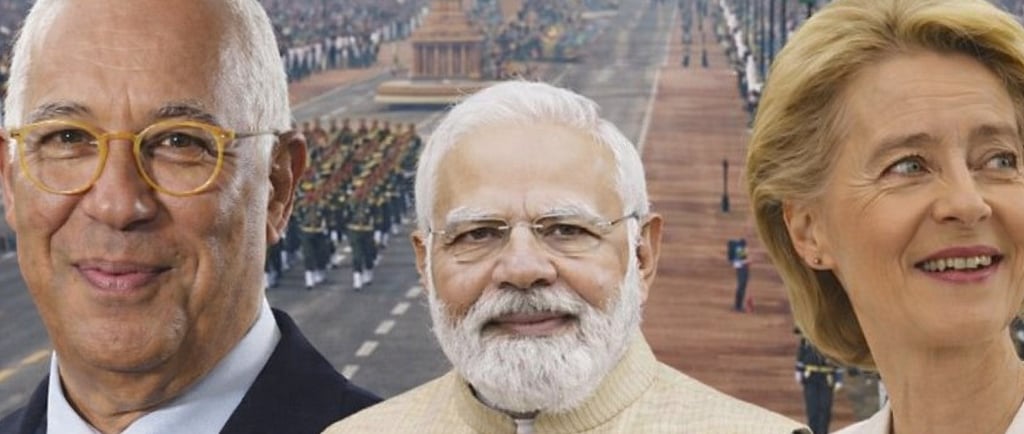
India is poised to clinch one of its most significant trade agreements in decades as negotiations with the European Union enter their final phase, with both sides racing to finalize a comprehensive Free Trade Agreement before top EU leaders arrive in New Delhi for Republic Day celebrations and a high-level summit on January 27, 2026. The breakthrough comes at a critical juncture for global trade, with India pivoting toward Europe as negotiations with Washington face delays and geopolitical uncertainties reshape traditional alliances.
European Commission President Ursula von der Leyen and European Council President António Luís Santos da Costa will become the first EU leaders to serve as chief guests at India's Republic Day parade on January 26, underscoring the strategic importance both sides attach to deepening their partnership. The visit will culminate in the 16th India-EU Summit the following day, where Prime Minister Narendra Modi and the European leaders are expected to announce the conclusion of trade negotiations, launch a new Security and Defence Partnership, and set the framework for expanded cooperation across technology, climate action, and connectivity.
Twenty years in the making: The long road to a trade deal
India and the European Union first began discussing a comprehensive trade agreement in 2007, but talks stalled in 2013 amid disagreements over market access, intellectual property protections, and regulatory standards. The negotiations were formally relaunched in June 2022, reflecting both sides' recognition that the global economic and security landscape had fundamentally shifted, making their partnership more valuable and urgent than ever before.
Commerce Secretary Rajesh Agrawal told reporters in New Delhi on Thursday that negotiators have successfully closed 20 out of 24 chapters of the proposed Broad-based Trade and Investment Agreement, commonly referred to as the India-EU Free Trade Agreement. "We are very close to finalising the deal," Agrawal stated, adding that teams from both sides are working intensively to bridge remaining gaps before the leaders' meeting. "We are virtually engaged and we are trying to see if we can meet the timeline before our leaders meet."
The timing is particularly significant given that bilateral trade between India and the 27-nation European Union bloc reached approximately $140 billion in 2024, making the EU India's largest trading partner and positioning the agreement to unlock substantial new economic opportunities for businesses, workers, and consumers on both sides. European officials have expressed cautious optimism in recent briefings to member state ambassadors, indicating that while a few thorny issues remain unresolved, momentum toward conclusion is strong.
If all proceeds as planned, the two sides will announce the completion of negotiations at the January 27 summit, though the formal signing ceremony and legal procedures may follow in subsequent weeks or months. Such an announcement would represent a major diplomatic and economic victory for Prime Minister Modi's government, which has sought to position India as a critical partner for democracies seeking to diversify supply chains away from excessive dependence on China and to build resilient trade networks aligned with shared values.
Stumbling blocks: Carbon taxes, agriculture, and regulatory alignment
Despite the progress, several contentious issues continue to complicate the final stages of negotiation. Chief among them is the European Union's Carbon Border Adjustment Mechanism, a tariff system that imposes fees on imports based on the carbon emissions embedded in their production. The CBAM came into effect on January 1, 2025, targeting sectors including steel, aluminum, cement, fertilizers, and electricity, and is designed to prevent "carbon leakage" by ensuring that imports face cost structures comparable to those imposed on EU producers under the bloc's climate regulations.
For India, the carbon tax represents a significant challenge because key export sectors such as steel and aluminum could face steep duties when entering European markets, potentially erasing gains from tariff reductions negotiated under the trade agreement. New Delhi has pressed for exemptions or carve-outs that would shield Indian exporters from the CBAM, arguing that developing countries with different energy profiles and historical emissions responsibilities should not be penalized for industrial activity that has long underpinned European and American prosperity.
European officials, however, have resisted granting blanket exemptions, emphasizing that the CBAM is central to the EU's climate ambitions under the European Green Deal and that differential treatment could undermine the mechanism's credibility and effectiveness. The disagreement reflects broader tensions over how to balance climate action with development imperatives, and how to allocate the costs of transitioning to low-carbon economies between advanced and emerging nations.
Agriculture remains another sticking point, with European Commission President Ursula von der Leyen confirming this week that the trade deal will exclude agricultural goods from its main provisions. The exclusion reflects political sensitivities within the EU, where farmers have mobilized repeatedly against trade agreements they view as threatening to domestic producers, and where concerns about food safety standards, environmental regulations, and rural livelihoods carry significant electoral weight.
Indian negotiators, meanwhile, have pushed for greater market access in services, particularly in sectors such as information technology, engineering, healthcare, and education where Indian firms are globally competitive. The two sides have also worked to align regulatory frameworks governing digital trade, data flows, and intellectual property, areas where differing standards and legal traditions have historically created friction.
A partnership beyond trade: Defence, security, and technology
While the trade agreement dominates headlines, the January 27 summit is expected to yield outcomes that extend well beyond tariffs and quotas. India and the European Union are finalizing a Security and Defence Partnership that will formalize cooperation on crisis management, maritime security, cyber defence, counterterrorism, and defence industrial collaboration. The partnership aims to secure supply chains, drive innovation, and boost production capabilities in an era when military and technological competition is intensifying across the Indo-Pacific and beyond.
Central to this defence cooperation is the proposed Security of Information Agreement, which will establish protocols for exchanging classified and sensitive information between India and EU member states. The SOIA is seen as a foundational step that will remove legal and procedural hurdles currently limiting joint exercises, intelligence sharing, and collaborative research and development in sensitive technologies.
India has expressed interest in participating in select projects under the European Union's Permanent Structured Cooperation framework, known as PESCO, which enables EU member states to pool resources and coordinate on defence capability development. Indian involvement in PESCO initiatives could facilitate technology transfers, co-production arrangements, and interoperability improvements that would benefit both sides, particularly as Europe seeks to reduce dependence on non-EU suppliers and India aims to modernize its armed forces and expand domestic defence manufacturing.
The defence dimension of the India-EU relationship has gained urgency in the context of Russia's ongoing military aggression against Ukraine, China's assertiveness in the Indo-Pacific, and the Trump administration's unpredictable approach to alliances and international commitments. European Council President António Costa emphasized that "India is a crucial partner for the EU. Together, we share the capacity and responsibility to protect the rules-based international order."
That language reflects a convergence of interests around preserving open sea lanes, upholding international law, countering terrorism and hybrid threats, and ensuring that disputes are resolved through dialogue and multilateral institutions rather than coercion and force. While India has maintained a nuanced position on Russia, balancing its long-standing defence ties with Moscow against Western pressures and its own strategic calculations, New Delhi and Brussels increasingly see eye to eye on the dangers posed by revisionist powers and the need for democracies to stand together.
Technology, connectivity, and climate: Expanding the agenda
The India-EU summit will also advance cooperation in emerging technologies, digital infrastructure, and climate action. Both sides have identified artificial intelligence, quantum computing, semiconductors, clean energy, and biotechnology as priority areas for joint research, investment, and standard-setting. A proposed EU-India Dialogue on Space aims to coordinate satellite launches, earth observation programs, and space exploration missions, while discussions on cybersecurity seek to build resilience against hacking, disinformation, and critical infrastructure attacks.
Connectivity is another pillar of the partnership, with India and Europe working to align their respective infrastructure initiatives and investment frameworks. The EU's Global Gateway strategy, launched as a response to China's Belt and Road Initiative, emphasizes sustainable, high-standard infrastructure development in partner countries, and India is viewed as a key node in building corridors that link Europe, West Asia, South Asia, and the Indo-Pacific.
The India-Middle East-Europe Economic Corridor, announced on the sidelines of the G20 summit in New Delhi in September 2023, envisions rail and shipping routes that would dramatically reduce transit times and costs for goods moving between India and Europe, while creating economic opportunities in Gulf states and neighboring regions. Progress on the corridor has faced challenges, including geopolitical tensions in the Middle East and financing complexities, but the January 27 summit is expected to reaffirm commitment to the project and outline next steps.
On climate, India and the EU have pledged to deepen collaboration on renewable energy deployment, green hydrogen production, energy storage technologies, and circular economy practices. The EU has committed billions of euros in climate finance and technology transfer to support developing countries' transitions to low-carbon pathways, and India, with its ambitious renewable energy targets and growing clean tech sector, is a priority recipient. However, disagreements over the CBAM and over historical responsibility for emissions continue to complicate negotiations, illustrating the difficulties inherent in aligning climate ambition with economic development and equity concerns.
Symbolism and substance: EU leaders at Republic Day
The decision to invite European Commission President Ursula von der Leyen and European Council President António Costa as chief guests for India's Republic Day parade carries deep symbolic weight. Republic Day, celebrated on January 26, commemorates the adoption of India's Constitution in 1950 and is marked by a grand military parade showcasing the country's armed forces, cultural diversity, and technological achievements.
Chief guests at Republic Day are traditionally heads of state or government from countries with which India seeks to strengthen ties, and the choice reflects New Delhi's strategic priorities for the year ahead. Inviting the EU's top leaders signals India's commitment to a comprehensive partnership with Europe at a time when the transatlantic alliance faces strains and when India is positioning itself as a bridge between the Global South and advanced democracies.
For the European Union, accepting the invitation and dispatching both the Commission President and the Council President underscores the bloc's view of India as an indispensable partner in addressing global challenges from climate change to trade to security. The joint appearance also projects unity and coherence at a time when the EU faces internal divisions over migration, fiscal policy, enlargement, and its relationship with the United States under the Trump administration.
During their state visit from January 25 to 27, von der Leyen and Costa will hold meetings with Prime Minister Modi, President Droupadi Murmu, and other senior Indian officials. They are also expected to engage with business leaders, civil society representatives, and academic institutions, highlighting the people-to-people dimensions of the India-EU relationship that extend beyond government-to-government cooperation.
Challenges ahead: Implementation, politics, and global headwinds
While the anticipated announcements at the January 27 summit represent significant achievements, the real test will come in implementation. Trade agreements, no matter how carefully negotiated, often encounter political resistance, bureaucratic delays, and unforeseen disputes during the ratification and rollout phases. The India-EU agreement will need to be approved by the European Parliament and by India's Parliament, processes that could take months and may surface opposition from interest groups concerned about competition, labor standards, environmental protections, or sovereignty.
The defence and security partnership will require sustained political commitment and funding to move from declarations of intent to operational cooperation. Trust-building takes time, especially in areas involving classified information and sensitive technologies, and both sides will need to demonstrate that the partnership delivers tangible benefits in terms of enhanced security, industrial opportunities, and strategic influence.
External factors also loom large. The global economic outlook remains uncertain, with growth slowing in major economies, inflation pressures persisting, and debt burdens constraining government spending. Geopolitical tensions in Ukraine, the Middle East, and the Taiwan Strait create risks of escalation that could disrupt trade, investment, and diplomatic priorities. The Trump administration's approach to tariffs, alliances, and international institutions adds another layer of unpredictability, potentially complicating India's and Europe's efforts to maintain rules-based global governance.
Nevertheless, the India-EU summit on January 27 represents a moment of opportunity and ambition. If the trade deal is concluded, it will be one of the most consequential economic agreements of the decade, reshaping supply chains, investment flows, and competitive dynamics across multiple sectors. If the defence partnership is launched, it will mark a new chapter in India-Europe security cooperation with implications for the Indo-Pacific balance of power and for efforts to uphold international norms. And if the broader strategic agenda is advanced, it will demonstrate that democracies can work together effectively to address shared challenges, even in an era of deepening rivalries and fragmenting multilateralism.
As European leaders prepare to take their places on the dais at India's Republic Day parade, they will be witnessing not just a celebration of Indian democracy and constitutional values, but a signal of India's rising global stature and its determination to shape the international order in the 21st century. The decisions made and announced in the days surrounding January 27 will reverberate far beyond New Delhi and Brussels, influencing trade negotiations, security alignments, and power dynamics from Washington to Beijing and beyond.
Updates
Delivering timely news and inspiring life stories.
Links
Contact
+917976343438
© 2025. All rights reserved.