
India's IT Giants Hit by ₹4,373 Crore Labour Code Bomb: TCS, Infosys, HCLTech Take Massive Q3 Charges as New Wage Rules Reshape Industry Economics
TCS, Infosys and HCLTech report combined exceptional charges of ₹4,373 crore in Q3 FY2026 due to new labour code implementation, squeezing margins despite steady revenue growth.
BUSINESS & CORPORATE ECONOMY
Sandeep Gawdiya
1/16/20269 min read
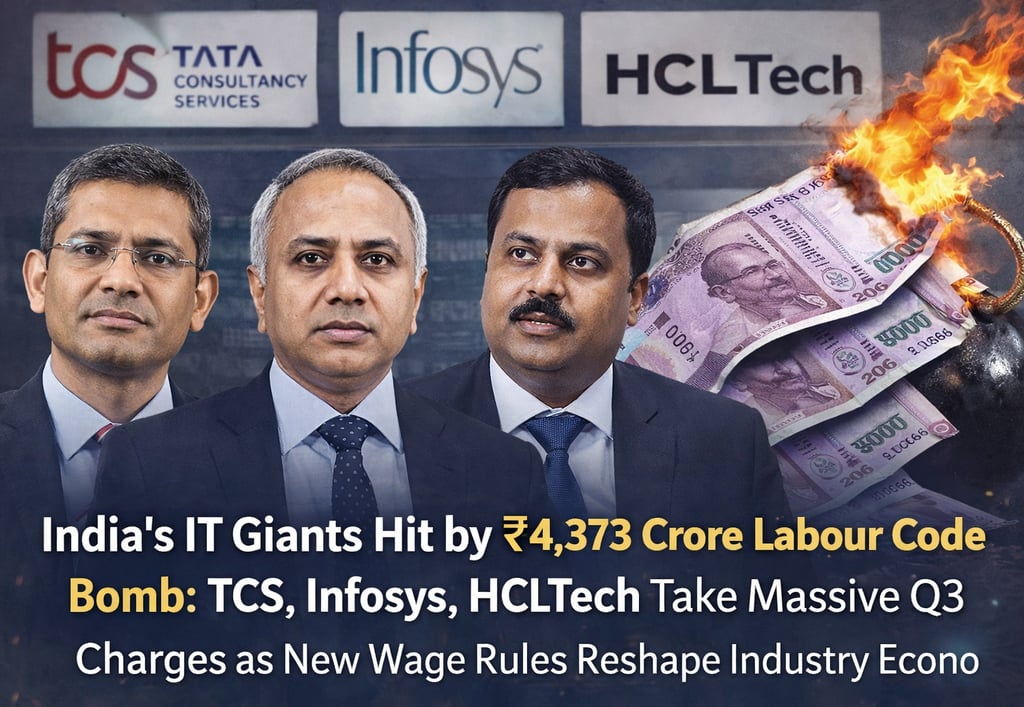
India's three largest information technology services companies have been hit by a massive regulatory compliance burden, collectively booking exceptional charges totaling ₹4,373 crore in the third quarter of fiscal year 2026 to account for the implementation of new labour codes that fundamentally reshape how employee benefits and compensation are calculated. The one-time accounting provisions, disclosed in recent earnings reports, represent a significant dent to quarterly profits for Tata Consultancy Services, Infosys, and HCLTech, and signal broader cost pressures that will affect the entire Indian IT sector as hundreds of companies adjust to the new legal framework.
The charges stem from labour law reforms that consolidated and modernized dozens of existing statutes governing wages, social security, industrial relations, and occupational safety, with key provisions taking effect in November 2025 after years of delays and consultations. While policymakers framed the reforms as necessary to protect worker rights, simplify compliance, and bring India's labour regulations in line with international standards, companies warn that the transition costs and ongoing expense increases threaten to compress margins in a highly competitive global market where Indian IT firms have traditionally competed on cost efficiency and operational excellence.
The impact extends beyond just the three headline names, with mid-sized IT firms, technology startups, and business process outsourcing companies also grappling with similar charges and adjusting business models to absorb higher personnel costs. Industry analysts estimate that ongoing recurring impacts could increase employee-related expenses by 3 to 5 percent in subsequent quarters, forcing companies to offset the burden through automation, productivity gains, pricing adjustments, or operational restructuring that may include workforce reductions or offshoring adjustments.
Breaking down the numbers: How each IT giant was affected
Tata Consultancy Services, India's largest IT services exporter and a bellwether for the sector, recorded the steepest hit, booking an exceptional expense of ₹2,128 crore in the December quarter related to increased liabilities for gratuity, leave encashment, and other employee benefit provisions mandated under the new codes. The charge represented a substantial portion of TCS's net profit for the quarter, though the company emphasized that the impact was largely non-recurring and reflected past service obligations rather than a fundamental deterioration in business performance.
Infosys, the second-largest player, recognized a ₹1,289 crore charge tied to enhanced gratuity and leave provisions required under the updated regulatory framework. The Bengaluru-based company, which had previously flagged the impending accounting impact in earlier guidance, saw its reported margins compress as the one-time provision flowed through the income statement. Executives reiterated during the earnings call that underlying demand trends remained intact and that the regulatory adjustment would not alter long-term growth targets or investment priorities.
HCLTech, the third member of India's big three IT services firms, recorded approximately ₹956 crore in one-time costs related to labour code compliance, reflecting similar increases in employee benefit liabilities based on the new wage definitions and tenure rules. The Noida-headquartered company, which has been investing heavily in automation and artificial intelligence to improve operational efficiency, indicated that it would look to technology-driven productivity improvements to partially mitigate the ongoing impact of higher personnel costs.
Combined, the ₹4,373 crore in exceptional charges across the three companies highlight the magnitude of the regulatory shift and the financial burden that compliance imposes on even the most profitable and well-managed enterprises in the sector. Smaller IT firms that lack the scale, margins, and financial cushion of industry leaders may face even greater challenges in absorbing the costs, potentially leading to consolidation, closures, or exits from certain business segments.
Understanding the new labour codes: What changed and why it matters
The labour code reforms, which the Indian government began drafting nearly a decade ago, aimed to simplify and modernize a patchwork of more than 40 central and state labour laws that had accumulated since independence and were widely criticized as outdated, contradictory, and difficult to comply with. The four new codes — on wages, social security, industrial relations, and occupational safety — consolidate these laws into a more streamlined framework while updating definitions, extending coverage, and enhancing worker protections in ways that reflect evolving employment patterns and international labor standards.
The most significant change affecting IT companies involves the redefinition of "wages" for calculating statutory benefits such as provident fund contributions, gratuity payments, and leave encashment. Under the previous regime, basic pay and dearness allowance typically constituted 25 to 40 percent of total compensation, with the remainder classified as allowances, bonuses, or perquisites that were excluded from benefit calculations. The new codes mandate that basic pay and dearness allowance must constitute at least 50 percent of total compensation, effectively expanding the base on which statutory benefits are computed.
This seemingly technical accounting change has profound financial implications. Because employer contributions to employee provident funds, gratuity liabilities, and leave encashment obligations are all calculated as percentages of basic pay, increasing the basic pay component automatically increases these costs. Employers are mandated to contribute at least 12 percent of an employee's basic salary monthly toward their provident fund, so a larger basic pay means higher mandatory contributions. Gratuity, which is paid when employees leave the company, is calculated based on years of service and last drawn basic salary, so a higher basic component translates directly into larger gratuity liabilities that companies must recognize and fund.
Another major change reduces the service tenure required for fixed-term employees to become eligible for gratuity from five years to just one year. This provision, intended to protect contract and temporary workers, expands the pool of employees for whom companies must recognize gratuity obligations and accelerates the timeline for when those liabilities accrue. For IT services firms that employ significant numbers of fixed-term contract workers on client projects, this rule change materially increases provisions and cash outflows.
The codes also introduce new reporting requirements, stricter penalties for non-compliance, and expanded definitions of who qualifies as an employee entitled to benefits, all of which add administrative complexity and legal risk. Companies must now maintain more detailed records, file additional documentation with labor authorities, and ensure that compensation structures across thousands of employees and multiple locations comply with the new mandates.
The financial impact: One-time hits and recurring pressures
Brokerages and financial analysts tracking the IT sector have been parsing the earnings reports and company disclosures to understand both the immediate accounting impact and the longer-term implications for profitability and competitiveness. Jefferies, a leading investment bank, noted in a research report that while the labour code charges are largely one-time in nature as companies adjust historical liabilities and recognize past service obligations, the gross recurring impact could increase employee costs by up to 5 percent in upcoming quarters.
This recurring cost increase stems from the fact that ongoing salary payments, provident fund contributions, and benefit accruals will all be calculated using the new higher basic pay component, making each employee incrementally more expensive for the company even if total compensation packages remain unchanged. For a sector that employs more than 5 million people directly and where personnel costs typically represent 50 to 60 percent of revenue, even a 3 to 5 percent increase in those costs can significantly compress operating margins and profitability.
The situation is particularly worrying for IT companies because they face a double squeeze: not only do they have the one-time accounting provisions that dent current quarter profits by 10 to 20 percent in some cases, but they also must contend with permanently higher recurring costs that affect competitiveness in global markets where clients are price-sensitive and alternative suppliers are constantly emerging. Indian IT firms have traditionally competed based on a combination of technical skills, English language proficiency, time zone advantages, and — critically — cost efficiency relative to Western competitors or alternative offshore locations.
If the labour code changes erode that cost advantage by making Indian IT workers more expensive on an all-in basis including benefits and compliance costs, companies may find it harder to win new business, retain existing clients who face budget pressures, or justify price increases that fully offset their higher internal costs. This dynamic could accelerate trends that were already underway, including greater use of automation and AI to reduce headcount, increased hiring in even lower-cost locations such as the Philippines or Eastern Europe, and efforts to move up the value chain toward higher-margin consulting and digital transformation services where cost is less decisive than expertise and relationships.
Investor reaction and market implications
The stock market reaction to the labour code charges has been relatively muted, with shares of TCS, Infosys, and HCLTech experiencing only modest declines following the earnings announcements, suggesting that investors had largely anticipated the impact and are focused more on underlying business fundamentals and future growth prospects than on one-time accounting provisions. Analyst commentary has emphasized that the charges are non-cash in nature for the most part, reflecting re-measurement of liabilities rather than immediate cash outflows, and that the companies remain highly profitable with strong balance sheets and cash generation.
However, there is concern about the precedent and the potential for further regulatory interventions that could impose additional costs or constraints on how companies operate. India's technology sector has long benefited from relatively light-touch regulation and government policies aimed at promoting growth, employment, and exports. The labour code reforms, while broadly positive in their intent to protect workers and modernize outdated laws, represent a shift toward more active regulation of employment relationships and compensation structures, and companies worry about what might come next.
Some executives and industry associations have privately expressed frustration that the reforms were implemented with relatively short notice and limited consultation on the specific implementation mechanics that would minimize disruption and cost. They argue that a more gradual phase-in, targeted exemptions for export-oriented sectors facing global competition, or offsetting measures such as tax incentives or regulatory relief in other areas could have cushioned the blow and preserved competitiveness.
Government officials, for their part, have defended the reforms as long overdue and essential for ensuring that India's rapidly growing service sector provides decent work and adequate social protection for its employees. They point out that the previous system, with its low basic pay components and heavy reliance on allowances, often resulted in inadequate provident fund accumulations and retirement savings for workers, leaving them vulnerable in old age or during economic downturns. By mandating higher basic pay and expanding benefit coverage, the codes aim to improve financial security for millions of workers and reduce inequality in an economy where informal and precarious employment remains widespread.
Broader implications for Indian IT and the future of work
The labour code charges hitting TCS, Infosys, and HCLTech are just the opening chapter in a longer story of how India's technology sector adapts to a changing regulatory and competitive landscape. Over the coming quarters, hundreds of other IT and business services companies will report similar charges as they comply with the new rules, and the cumulative impact will run into tens of thousands of crores across the sector.
Beyond the immediate financial hit, the reforms are likely to accelerate structural changes that were already reshaping the industry. Automation and artificial intelligence, which were being adopted gradually to improve efficiency and handle routine tasks, may now be deployed more aggressively as companies seek to reduce headcount and lower the per-unit cost of delivering services. Jobs that involve repetitive, rule-based work — such as application maintenance, testing, helpdesk support, and data entry — are particularly vulnerable to automation, and the labour code changes provide an additional economic incentive to invest in technologies that can replace or augment human workers.
Outsourcing and offshoring within India may also shift, with companies potentially moving work from high-cost metros like Bangalore, Hyderabad, and Pune to tier-2 and tier-3 cities where real estate, living costs, and wage expectations are lower. Some firms may also explore nearshoring or reshoring certain functions to client locations if the cost differential with India narrows sufficiently or if clients demand greater proximity and control over critical operations.
The move up the value chain toward consulting, digital transformation, cloud migration, cybersecurity, and other higher-margin services becomes even more urgent in this environment. Companies that can differentiate based on expertise, innovation, and strategic partnership rather than competing primarily on cost will be better positioned to absorb higher labor expenses and sustain profitability. This shift may also drive M&A activity as firms seek to acquire specialized capabilities, enter new markets, or achieve greater scale and efficiency.
For employees, the labour code changes represent a mixed bag. On the positive side, higher basic pay components mean larger provident fund contributions and retirement savings, and the extension of gratuity eligibility to fixed-term workers provides greater financial security. However, if companies respond to higher costs by limiting hiring, freezing salaries, reducing discretionary bonuses, or accelerating automation, the net effect on employment and take-home pay could be negative for some workers, particularly those in vulnerable or easily automated roles.
The road ahead: Adaptation, innovation, and competitive dynamics
As India's IT sector digests the ₹4,373 crore charge taken by its three giants and prepares for the ongoing cost increases embedded in the new labour codes, the focus is shifting from one-time accounting provisions to strategic responses that will determine winners and losers in the years ahead. Companies with strong client relationships, diversified service offerings, robust automation capabilities, and efficient operations will likely weather the transition more successfully than those dependent on low-cost labor arbitrage alone.
Investors watching Q4 earnings reports should expect similar one-time charges from other technology firms that have not yet disclosed results, suggesting this is a sector-wide phenomenon as companies align with the updated regulatory framework. The cumulative impact across hundreds of firms, including mid-sized players, startups, and business process outsourcing companies, will run into the tens of thousands of crores and will be closely watched as a barometer of how India's labor market and regulatory environment are evolving.
Policymakers, meanwhile, face the challenge of balancing worker protection and social equity with the need to maintain India's competitiveness in global markets and preserve the country's position as the world's leading provider of IT and business services. The labour codes represent a step toward that balance, but the implementation challenges, cost impacts, and unintended consequences will need to be monitored and addressed through ongoing dialogue between government, industry, and worker representatives.
For now, the message is clear: the era of ultra-low labor costs and minimal regulatory burdens that powered India's IT boom in the 1990s and 2000s is over. The sector is maturing, and with that maturity comes greater responsibility to provide decent work, adequate benefits, and fair treatment for employees. How companies adapt to this new reality will shape not just their own fortunes, but the future of India's knowledge economy and its role in the global digital ecosystem.
Updates
Delivering timely news and inspiring life stories.
Links
Contact
+917976343438
© 2025. All rights reserved.