
Jeddah Tower: The World’s Tallest Skyscraper Redefining Human Ambition
Saudi Arabia’s Jeddah Tower is rising to become the world’s tallest skyscraper, surpassing the one-kilometre mark and redefining global limits of architecture, engineering and urban ambition. Designed as a vertical city on the Red Sea coast, the project reflects the Kingdom’s Vision 2030 goals, blending luxury living, tourism, business and innovation into a single landmark set to reshape skylines and perceptions worldwide.
ARCHITECTURE
Sandeep
1/12/20265 min read
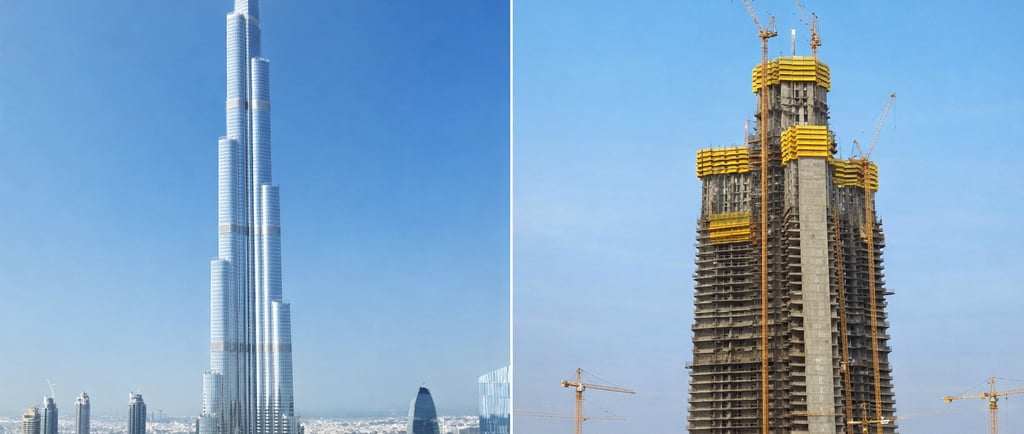
Saudi Arabia is once again capturing global attention as Jeddah Tower accelerates toward becoming the world’s tallest skyscraper, officially surpassing 80 floors and moving steadily toward its ambitious one-kilometre height target, a milestone that would eclipse Dubai’s iconic Burj Khalifa by nearly 200 metres. Designed as a futuristic “vertical city,” the tower is the centrepiece of Jeddah Economic City and a flagship symbol of Saudi Arabia’s Vision 2030, blending luxury hotels, premium residences, high-end offices, retail districts and the planet’s highest observation deck into a single, record-breaking structure. Construction, which resumed in 2024–2025 after years of delays, is now advancing rapidly with completion targeted for the late 2020s, according to recent updates reported by Newsweek. Engineered by Adrian Smith + Gordon Gill Architecture, the same firm behind Burj Khalifa, the tower features an aerodynamic tapered form, a reinforced concrete-steel core, ultra-deep foundations, and smart energy-efficient façades to withstand extreme wind, heat and structural loads at unprecedented heights. More than just a race for records, Jeddah Tower reflects Saudi Arabia’s broader push to redefine its global image through mega-infrastructure, tourism and innovation, signaling a shift from oil-centric growth toward future-ready cities that aim to leave a lasting mark on the world skyline.
Beyond its headline-grabbing height, Jeddah Tower is being shaped as a fully functional vertical city that reflects Saudi Arabia’s long-term urban and economic ambitions, rather than a standalone monument. Rising along the Red Sea coast, the tower will host luxury hotels, elite residential apartments with sweeping sea views, premium office spaces, retail and hospitality zones, and the world’s highest observation deck, all connected by some of the fastest high-speed elevators ever installed. Built as the anchor of Jeddah Economic City, the project aligns closely with Vision 2030, aiming to position Jeddah as a global tourism, business and innovation hub. Advanced climate-control systems, energy-efficient façades and smart building technologies are being integrated to manage heat, wind pressure and sustainability challenges at extreme altitude, highlighting how the tower is as much about future-ready urban living as it is about breaking records. More than competing with Burj Khalifa, Jeddah Tower signals Saudi Arabia’s intent to redefine city-making at scale—where engineering ambition, luxury, and national transformation converge in a single skyline-defining structure.
What truly sets Jeddah Tower apart is the scale of engineering and sustainability thinking required to push human construction beyond the one-kilometre mark, a challenge few projects in history have dared to attempt. At such extreme heights, wind forces, temperature variation, material stress and vertical transportation become as critical as architectural vision, which is why the tower employs a tapered aerodynamic shape, a massively reinforced concrete-steel core, and ultra-deep foundations designed to carry unprecedented loads. Smart building systems will continuously monitor safety, energy use and climate control, while high-performance façades are engineered to reduce heat gain in the harsh Red Sea climate. The project also represents a major economic statement, backed by significant Saudi investment and intended to catalyse tourism, global business interest and long-term employment as part of the Kingdom’s urban transformation. Rather than simply aiming to surpass Burj Khalifa, Jeddah Tower reflects a broader shift in Saudi Arabia’s development strategy—where record-breaking architecture is used as a tool to reshape cities, diversify the economy, and project confidence on the global stage for decades to come.
When Jeddah Tower is finally completed, it is expected to stand not just as the world’s tallest building but as a lasting symbol of Saudi Arabia’s transformation in the 21st century, redefining how ambition, urban planning and national vision intersect. Towering over the Red Sea skyline, it will signal the Kingdom’s shift from oil-driven identity toward a diversified future built on tourism, global investment, advanced engineering and iconic city-making under Vision 2030. More than a comparison with Burj Khalifa, Jeddah Tower represents a new chapter where scale is matched with purpose—anchoring an entire urban ecosystem, attracting international attention, and reshaping how Saudi cities are perceived worldwide. Once opened, it will not simply change record books, but permanently alter the global skyline and the narrative of what modern megacities can achieve.
Looking ahead, Jeddah Tower is expected to influence how future supertall and megatall buildings are conceived worldwide, pushing architects and engineers to rethink limits of height, safety, sustainability and human experience at extreme scales. As cities grow denser and land becomes more constrained, the tower’s vertical-city model—where living, working, leisure and tourism coexist within a single structure—could become a blueprint for next-generation urban development. Its success will likely inspire similar mega-projects across Asia, the Middle East and Africa, while reinforcing Saudi Arabia’s role as a global leader in bold infrastructure and architectural experimentation. In this sense, Jeddah Tower is not just a national landmark in the making, but a global reference point that may redefine how future skylines are imagined, built and experienced long after it officially opens.
From a tourism and global branding perspective, Jeddah Tower is poised to become one of the most recognisable landmarks on Earth, drawing visitors, investors and media attention on a scale few structures can match. Much like how Burj Khalifa transformed Dubai into a must-visit global destination, Jeddah Tower is expected to elevate Saudi Arabia’s tourism profile by offering unparalleled experiences such as the world’s highest observation deck, luxury hospitality at extreme altitudes, and panoramic Red Sea views. Integrated within a broader urban and tourism ecosystem, the tower will act as a powerful magnet for international travel, events and high-end development, reinforcing the Kingdom’s ambition to position itself as a leading cultural and economic hub under Vision 2030.
At a deeper level, Jeddah Tower also represents a powerful instrument of soft power, signaling Saudi Arabia’s growing confidence and ambition on the global stage. In an era where iconic infrastructure shapes international perception, the tower is designed to communicate openness, technological capability, and future readiness—reshaping how the Kingdom is viewed beyond energy markets and geopolitics. Much as landmark projects once rebranded cities like Dubai and Shanghai, Jeddah Tower is expected to position Saudi Arabia as a centre of innovation, design leadership and mega-scale execution, aligned with the broader narrative of Vision 2030. More than steel and concrete, it becomes a global statement that Saudi Arabia intends to compete not only economically, but symbolically, using architecture to project influence, aspiration and long-term vision to the world.
Ultimately, the legacy of Jeddah Tower is likely to extend far beyond its physical height, shaping how future generations understand ambition, progress and the role of architecture in national storytelling. As cities around the world grapple with climate pressure, population growth and the need for smarter land use, the tower’s vertical-city concept offers a provocative vision of how density, luxury and functionality can coexist at unprecedented scale. For Saudi Arabia, it will stand as a long-term cultural marker of a transformational era under Vision 2030, capturing a moment when the Kingdom chose to redefine itself through innovation, confidence and global engagement. Long after construction cranes disappear, Jeddah Tower is expected to remain a reference point in architectural history—a reminder of how far human imagination and engineering dared to reach toward the sky.
When the doors of Jeddah Tower finally open, it will mark far more than the completion of a construction project—it will represent a defining moment in human ambition and engineering history. Surpassing the one-kilometre height barrier will reset global benchmarks for architecture, drawing worldwide attention and cementing the tower’s place as a symbol of modern perseverance and vision. For Saudi Arabia, the moment will reflect years of determination through delays and technical challenges, culminating in a structure that embodies resilience, innovation and long-term national planning. As the world looks up at the new tallest building on Earth, Jeddah Tower will stand not just as a record-breaker, but as a powerful reminder that the future of cities is shaped by bold ideas, strategic vision and the courage to build beyond known limits.
Updates
Delivering timely news and inspiring life stories.
Links
Contact
+917976343438
© 2025. All rights reserved.