
Pentagon Mobilizes 1,500 Combat Troops for Minnesota as Trump Inches Toward Historic Insurrection Act Invocation
Alaska-based Arctic infantry units receive deployment orders as Minneapolis violence escalates, marking potential first use of military force against domestic protesters since 1992 riots
U.S. POLITICS & DOMESTIC SECURITY
Sandeep Gawdiya
1/19/20269 min read
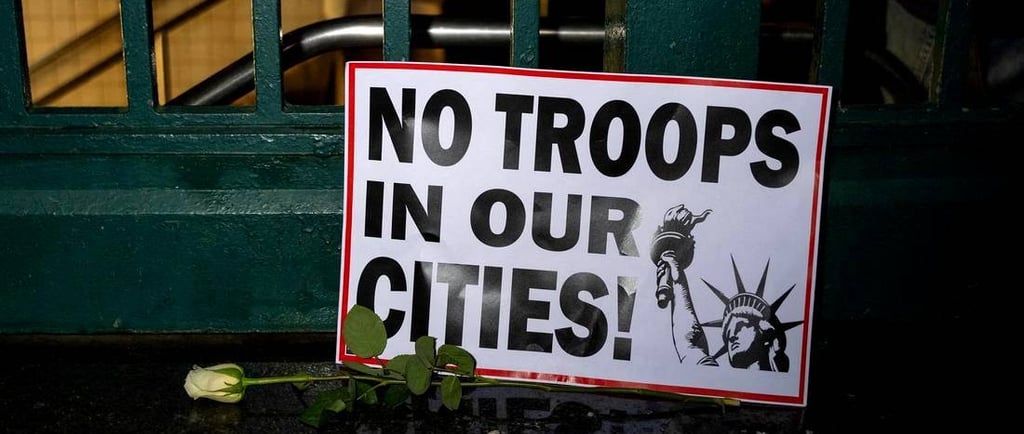
The United States Pentagon has ordered approximately 1,500 active-duty combat soldiers stationed in Alaska to prepare for possible deployment to Minnesota within days, defense officials confirmed late Saturday—the strongest signal yet that President Donald Trump intends to invoke the Insurrection Act and deploy federal military forces against American citizens protesting immigration enforcement operations in Minneapolis. The extraordinary mobilization of two full infantry battalions from the Army's elite 11th Airborne Division represents the most serious domestic military deployment since the 1992 Los Angeles riots and would mark the first time a president has used active-duty troops to suppress protests triggered by federal law enforcement's own actions.
The prepare-to-deploy orders, issued Saturday evening to cold-weather warfare specialists based at Fort Wainwright and Joint Base Elmendorf-Richardson in Alaska, follow Trump's repeated threats to invoke the 1807 Insurrection Act—a rarely used law that grants presidents sweeping authority to deploy military forces domestically without congressional approval or state consent. The mobilization comes as tensions in Minneapolis have exploded into sustained violence following the January 7 fatal shooting of Renee Good, a 37-year-old mother of three and U.S. citizen, by an Immigration and Customs Enforcement agent—a killing that has transformed Minnesota's largest city into a powder keg of rage, protest, and escalating confrontations between federal agents, local law enforcement, state officials, and thousands of furious demonstrators.
The Arctic Infantry: Cold-Weather Warriors Head to Minnesota
The soldiers receiving deployment orders belong to two infantry battalions within the 11th Airborne Division, a specialized unit formerly known as the 25th Infantry Division (Light) that rebranded in 2022 to emphasize Arctic warfare capabilities. These troops—stationed in Alaska where winter temperatures routinely plunge to minus-40 degrees Fahrenheit—train specifically for combat operations in extreme cold weather environments, making them uniquely suited for potential operations in Minnesota's brutal January climate.
"The Army has issued prepare-to-deploy orders to these units in anticipation of escalating violence in Minnesota," explained defense officials speaking on condition of anonymity to discuss sensitive military planning. The orders represent "prudent planning" for potential deployment, though officials emphasized that no final decision has been made about actually sending troops into Minneapolis.
The prepare-to-deploy designation constitutes a formal military readiness status that requires units to complete final preparations for overseas or domestic deployment on short notice—typically 24-96 hours. Soldiers check and pack equipment, receive intelligence briefings about their potential operating environment, review rules of engagement, and ensure personal affairs are in order before deployment. For the 11th Airborne battalions, this means preparing for potential combat operations not in Afghanistan, Iraq, or the Pacific theater—but on American streets against American citizens.
The deployment would mark the first time the 11th Airborne Division has conducted domestic operations since its reactivation. The unit's predecessor, the 25th Infantry Division, participated in the federal response to Hurricane Katrina in 2005—but that was a humanitarian relief mission, not law enforcement or crowd control against protesters. Deploying combat infantry trained for warfare against domestic demonstrators represents a fundamentally different and far more controversial use of military force.
White House Signals: "Standard Practice" or Unprecedented Escalation?
The White House attempted to downplay the extraordinary nature of the Pentagon's orders, with press secretary issuing a brief statement suggesting the military preparations constitute "standard practice" for ensuring presidential readiness options. However, military historians and constitutional law experts immediately challenged this characterization, noting that preparing active-duty combat units for deployment against domestic protesters is anything but standard in American history.
"This is not normal," emphasized Elizabeth Goitein, director of the Liberty and National Security Program at the Brennan Center for Justice. "Preparing active-duty combat troops for deployment against American citizens exercising First Amendment rights is extraordinary. The administration is normalizing what should be viewed as a profound crisis—the potential use of military force against the American people."
President Trump has made his intentions clear through increasingly inflammatory statements on social media and in public appearances. "If the corrupt Governor of Minnesota won't obey the law and stop the professional agitators and insurrectionists attacking the Patriots of ICE, who are only trying to do their jobs, I will institute the INSURRECTION ACT," Trump declared on Truth Social, his preferred social media platform.
The President's characterization of Minneapolis protests as an "insurrection" reflects a deliberate framing strategy designed to justify extraordinary measures. By portraying demonstrations against federal immigration enforcement as tantamount to rebellion against the United States government, Trump creates rhetorical justification for invoking the Insurrection Act's sweeping authorities.
The Insurrection Act: What It Is and Why It Matters
The Insurrection Act—actually a collection of laws passed between 1792 and 1871—grants the President authority to deploy federal military forces and federalize National Guard units for domestic law enforcement purposes, overriding the Posse Comitatus Act's general prohibition on using military for civilian police functions. The Act contains few constraints on presidential discretion, no explicit time limits, and minimal judicial oversight once invoked.
Three principal sections authorize different types of deployments:
Section 251 permits deployment when a state legislature (or governor if the legislature cannot convene) requests federal assistance to suppress an insurrection. This clearly does not apply in Minnesota, where Governor Tim Walz has explicitly opposed federal military deployment and mobilized the Minnesota National Guard under state control to protect protesters' constitutional rights rather than suppress demonstrations.
Section 252 authorizes deployment when "unlawful obstructions, combinations, or assemblages" prevent execution of federal law to such a degree that ordinary enforcement measures prove inadequate. Trump's team argues this provision applies to Minneapolis, claiming protesters and local officials are conspiring to obstruct ICE operations.
Section 253—the broadest provision—permits deployment when domestic violence or conspiracy "hinders the execution of the laws" so severely that authorities cannot protect civil rights or execute federal laws. This section grants Presidents enormous discretion to determine when conditions justify military intervention.
Historically, the Insurrection Act has been invoked rarely and typically in circumstances dramatically different from the current Minneapolis situation. President Abraham Lincoln used it as legal basis for fighting the Civil War. President Dwight Eisenhower invoked it to enforce school desegregation in Little Rock, Arkansas in 1957, deploying the 101st Airborne Division to protect Black students entering previously all-white schools. President Lyndon Johnson used it during urban unrest in the 1960s. President George H.W. Bush invoked it during the 1992 Los Angeles riots following the Rodney King verdict.
But Trump would be the only president to invoke the Insurrection Act to deploy troops against protests triggered by federal law enforcement's own use of lethal force against civilians—a circular logic where federal agents kill a civilian, protests erupt against the killing, and the President deploys military forces to suppress those protests while characterizing demonstrators as insurrectionists.
Minnesota's Response: State vs. Federal Showdown
Governor Tim Walz has mobilized the Minnesota National Guard—but crucially, under state rather than federal control. The distinction matters enormously: Guard units operating under state authority answer to the governor and exist to protect Minnesota citizens and their constitutional rights. If federalized under the Insurrection Act, those same units would be removed from state control and would answer directly to the President and Pentagon, potentially being ordered to suppress the very protesters they were mobilized to protect.
Minnesota National Guard personnel will wear distinctive bright yellow vests over their uniforms if deployed—a visible marker designed to distinguish state forces from federal agents and troops. "Minnesota National Guard members live, work, and serve in our state, and are focused on protecting life, preserving property, and ensuring Minnesotans can safely exercise their First Amendment rights," the Guard stated, emphasizing their role supporting rather than suppressing protesters.
Governor Walz has made repeated direct appeals to President Trump to "turn the temperature down" and de-escalate rather than inflaming tensions through threats of military deployment. "This is not who we are," Walz pleaded. "I am making a direct appeal to the President: Let's turn the temperature down. Stop this campaign of retribution".
However, the Trump administration has responded to Walz's appeals not with de-escalation but with escalation—opening a criminal investigation into the governor and Minneapolis Mayor Jacob Frey for allegedly conspiring to obstruct federal law enforcement. Deputy Attorney General Todd Blanche accused both officials of "promoting violence against law enforcement" and labeled their actions "terrorism"—inflammatory rhetoric that appears designed to justify military intervention rather than seeking political resolution.
The Constitutional Crisis: Federal vs. State Authority
The looming Minnesota deployment represents a potential constitutional crisis that pits federal executive power against state sovereignty, with profound implications for American federalism. The Trump administration claims absolute authority to deploy military forces domestically whenever the President determines federal law enforcement faces obstruction. State officials argue that deploying combat troops against citizens without state consent—and indeed over state objections—violates constitutional principles of federalism and threatens to reduce states to administrative subdivisions subordinate to federal military power.
"This represents an unprecedented assertion of federal power," warned legal scholars. "Previous Insurrection Act invocations typically occurred with state cooperation or at state request, or involved clear civil rights violations that federal intervention aimed to remedy. Here, federal agents killed a civilian, protests erupted, and now the President threatens to deploy military forces to suppress dissent—all over state objections. That's a fundamentally different and far more dangerous precedent."
The Justice Department's criminal investigation into Walz and Frey adds another dimension to the crisis. By threatening state and local officials with federal prosecution for exercising First Amendment rights to criticize federal policy, the Trump administration appears to be using criminal law as a weapon to intimidate political opponents and discourage resistance to federal overreach.
What Deployment Would Look Like
If Trump orders the Alaska-based battalions to Minnesota, approximately 1,500 combat-trained soldiers would deploy to Minneapolis with full military equipment including rifles, body armor, communications gear, vehicles, and potentially heavier weapons systems. These troops would not be military police trained for crowd control—they are infantry soldiers trained for combat operations against enemy forces.
The deployment would likely follow patterns from previous domestic military operations. Troops would establish a command post, probably at a federal facility, and coordinate with ICE agents and other federal law enforcement. They would receive rules of engagement—guidelines governing when and how they can use force—though the specifics of those rules would be classified and unknown to protesters and the public.
Unlike the Minnesota National Guard's yellow vests, federal troops would wear standard military uniforms—making them visually indistinguishable from combat forces deployed overseas. They would carry loaded weapons and possess legal authority to use lethal force under circumstances defined by their classified rules of engagement.
The psychological impact of seeing active-duty combat soldiers patrolling American streets, establishing checkpoints, and confronting protesters cannot be overstated. For many Americans, such scenes evoke martial law, military dictatorship, or authoritarian regimes—not democratic governance. The damage to American democratic norms and international reputation would be profound and lasting.
Historical Context: Previous Domestic Deployments
The last major domestic deployment of active-duty troops occurred during the 1992 Los Angeles riots, when President George H.W. Bush sent Marines and Army soldiers to assist local law enforcement after widespread looting, arson, and violence erupted following the Rodney King verdict. That deployment—which faced significant criticism—at least responded to genuine widespread criminal violence and occurred with state cooperation after Governor Pete Wilson requested federal assistance.
The Trump administration's previous attempts to deploy military forces domestically have met mixed success. In 2020, Trump threatened to invoke the Insurrection Act to suppress George Floyd protests but was talked out of it by senior military and civilian advisors. Throughout 2025, Trump used a rarely-invoked statute to federalize and deploy National Guard forces in Los Angeles, Portland, and Chicago—actions that courts blocked as exceeding presidential authority.
The Insurrection Act would theoretically provide stronger legal grounds by explicitly authorizing military deployment without state consent. However, using the Act to suppress protests against federal law enforcement's own actions would test constitutional limits and likely trigger immediate litigation challenging the deployment's legality.
The Broader Implications
Beyond the immediate Minnesota crisis, the potential Insurrection Act invocation carries profound implications for American democracy and civil liberties. If a president can deploy combat troops to suppress domestic protests simply by characterizing dissent as "insurrection," then the First Amendment's protections become effectively meaningless whenever they conflict with executive preferences.
The precedent would empower future presidents—regardless of party—to militarize responses to domestic political conflict. Climate protests blocking oil pipelines? Deploy troops. Labor strikes disrupting commerce? Send in soldiers. Demonstrations against police violence? Call out the military. Once the Insurrection Act becomes a routine tool for managing domestic dissent rather than a last resort for genuine insurrection, American democracy crosses a rubicon from which recovery may prove impossible.
International implications extend beyond America's borders. For decades, the United States has criticized authoritarian regimes for using military forces against civilian protesters. How can America maintain moral authority to condemn Myanmar's junta, Belarus's crackdowns, or Venezuela's repression while deploying combat troops against its own citizens exercising constitutional rights?
What Happens Next
As the 1,500 Alaska-based soldiers complete deployment preparations, attention focuses on whether Trump actually issues deployment orders or uses the threat as leverage to extract concessions from Minnesota officials. The criminal investigation into Walz and Frey, combined with mobilization of combat troops, creates enormous pressure on state leaders to capitulate to federal demands.
However, capitulation carries its own costs. If state officials back down in the face of military threats, they establish a precedent that federal executive power can override state authority through intimidation. Future conflicts would be resolved not through constitutional processes but through federal willingness to deploy overwhelming force.
Alternatively, if Walz and state officials refuse to back down and Trump orders deployment, America enters uncharted constitutional territory. Federal combat troops confronting state National Guard units. Military forces patrolling American streets over state objections. Soldiers potentially facing orders to use force against American citizens. The scenarios grow increasingly dark.
As Monday morning arrives and soldiers in Alaska await final orders, America stands at a crossroads. Will the President step back from the brink, or will he take the historic and potentially catastrophic step of deploying combat troops against American protesters? The answer will define Trump's presidency and potentially determine whether American democracy survives its greatest stress test since the Civil War.
Updates
Delivering timely news and inspiring life stories.
Links
Contact
+917976343438
© 2025. All rights reserved.