
Putin Holds Phone Calls with Netanyahu and Iranian President in Urgent Bid to De-Escalate Middle East Tensions Amid Iran Crisis
Russian President Putin offers mediation between Israel and Iran as death toll from Iranian protests surpasses 3,400 and Trump weighs military intervention.
GEOPOLITICS & INTERNATIONAL DIPLOMACY
Sandeep Gawdiya
1/16/20267 min read
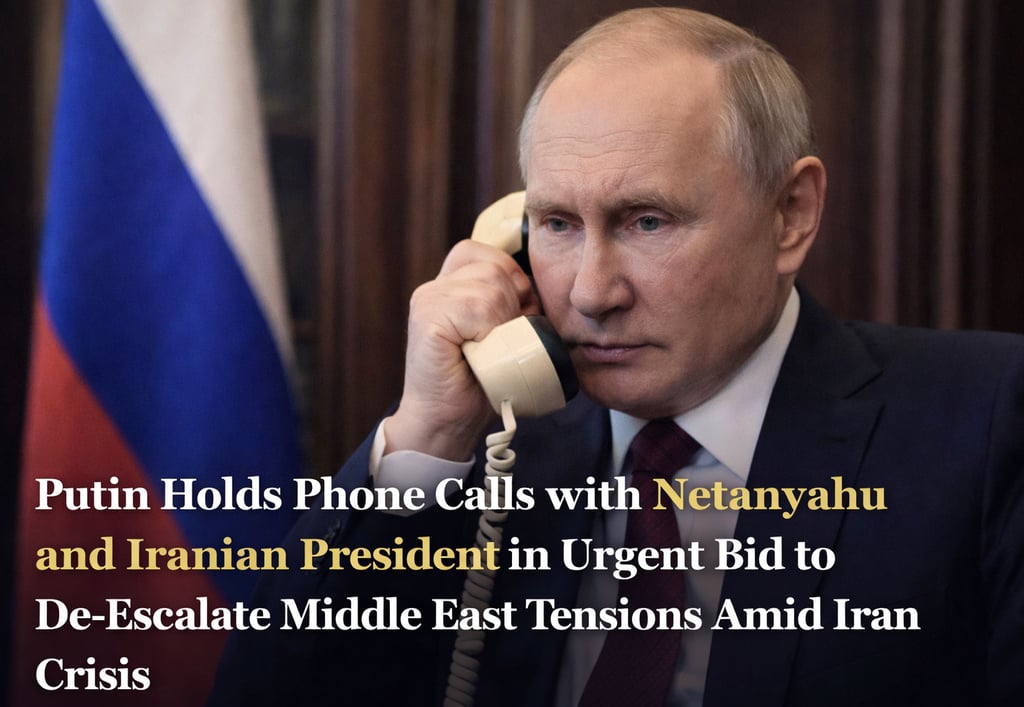
Putin Holds Phone Calls with Netanyahu and Iranian President in Urgent Bid to De-Escalate Middle East Tensions Amid Iran Crisis
Moscow positions itself as mediator as thousands killed in Iranian crackdown while United States threatens military action and regional stability hangs in balance
MOSCOW — Russian President Vladimir Putin conducted separate telephone conversations Friday with Israeli Prime Minister Benjamin Netanyahu and Iranian President Masoud Pezeshkian, offering Moscow's mediation services amid escalating regional tensions following Iran's violent suppression of nationwide protests that have left thousands dead and prompted threats of Western military intervention.
The Kremlin announced that Putin expressed Russia's readiness to "continue its mediation efforts and foster constructive dialogue involving all parties concerned" during his discussion with Netanyahu regarding the Middle East situation and Iran. Kremlin spokesman Dmitry Peskov indicated that details of the conversation with the Iranian president would be released shortly, emphasizing Putin's commitment to continuing de-escalation efforts in the region.
The diplomatic initiative comes as independent human rights monitors report Iranian security forces have killed thousands in a forceful response to anti-government demonstrations that began in late December 2025, raising fears of broader military confrontation involving the United States and Israel.
Staggering Death Toll Emerges from Iranian Crackdown
The scale of casualties from Iran's suppression of protests has shocked international observers, with multiple independent organizations documenting dramatically different figures that nonetheless all point to mass killings. The Norway-based Iran Human Rights organization reported Friday that at least 3,428 protesters across 15 provinces have been killed since demonstrations erupted on December 28, with the group noting that 3,379 deaths occurred between January 8 and January 12 during the most intense period of unrest.
The surge in documented deaths came after Iran Human Rights received new data from inside Iran's health and education ministries, providing unprecedented insight into the scope of the government's response. More than 10,000 people have been arrested during the crackdown, according to the organization.
The United States-based Human Rights Activists News Agency, known as HRANA, reported a more conservative but still staggering figure of 2,615 confirmed deaths by Wednesday, including 2,435 protesters, 153 individuals affiliated with government or military forces, and 14 bystanders. HRANA acknowledged it was investigating 579 additional reported deaths.
An unnamed Iranian official told Reuters that approximately 2,000 people died during the unrest, though the official blamed "terrorists" for the deaths rather than security forces. Iranian state television issued its first indirect acknowledgment of mass casualties, announcing that mass funerals in Tehran would include 300 bodies of security forces and civilians.
Perhaps most alarming, activist groups inside Iran, working with medical officials across the country, estimated the actual death toll could range between 12,000 and 20,000 based on medical reports, though these figures remain unverified. CBS News verified video footage showing bodies of at least 366 and possibly more than 400 people at a morgue in a Tehran suburb, with visible extensive injuries including gunshot wounds, shotgun wounds, and severe trauma.
Economic Collapse Ignites Nationwide Uprising
The protests erupted on December 28, 2025, when the Iranian rial collapsed to an all-time low against the United States dollar, triggering demonstrations that began among shopkeepers in Tehran's historic Grand Bazaar before spreading rapidly to numerous cities nationwide. The movement has since broadened beyond economic grievances into direct opposition to the ruling theocracy, including Supreme Leader Ayatollah Ali Khamenei.
"The recent unrest was undeniably rooted in economic distress," Hassan Hakimian, professor emeritus of economics at SOAS University of London, explained to Al Jazeera. "Decades of systemic corruption and extensive economic mismanagement have been exacerbated by international sanctions, increasing the suffering of countless ordinary citizens."
The immediate trigger came when Iran's central bank terminated a program allowing certain importers access to US dollars at subsidized rates below market prices, prompting merchants to dramatically increase prices or close businesses entirely as essential goods including cooking oil and chicken disappeared from store shelves. A controversial government budget proposing higher taxes while allocating 31 trillion tomans (approximately $365 million) to religious institutions and 210 trillion tomans ($2.32 billion) to security forces further inflamed public anger.
Iran's economy faces multiple compounding crises beyond currency collapse. Banking automated teller machines remain inoperative, flight and currency transactions are severely limited due to shutdown of the National Information Network—Iran's state-controlled domestic internet—and the country confronts critical water shortages, power outages, and severe air pollution. Chronic inflation, widespread poverty, and growing inequality have created what economists describe as a perfect storm of economic failure.
International sanctions targeting financial networks and entities associated with Iran's nuclear and ballistic missile programs, as well as the Islamic Revolutionary Guard Corps, have severely restricted the country's ability to conduct international business. China currently purchases over 80 percent of Iran's exported oil, with much transported via a "shadow fleet" of tankers using false flags or disabled tracking devices to evade sanctions, according to analytics firm Kpler.
Trump Weighs Military Intervention as Regional Tensions Escalate
United States President Donald Trump has repeatedly threatened military action against Iran if the government executes protesters or attempts to rebuild its nuclear program, dramatically raising stakes in the crisis. "The killing has stopped," Trump claimed earlier this week, suggesting Iranian authorities had responded to his warnings, though he emphasized he remained weighing military options.
Trump's threats carry particular weight given recent history. In June 2025, Israel conducted a 12-day military campaign against Iran involving unprecedented strikes on Iranian military and nuclear facilities, with the United States joining the operation by hitting three major Iranian nuclear sites. The conflict, which also saw Iran and Israel exchange missile strikes before agreeing to a ceasefire, fundamentally altered the strategic landscape of the Middle East.
Initial United States intelligence assessments concluded the strikes on Iranian nuclear facilities did not reach the program's core and likely only delayed nuclear development by several months, though Israeli officials claimed to have "destroyed" Iran's nuclear capabilities. Trump warned in December that if Iran attempts to rebuild its nuclear program, the United States will have "no choice but to very quickly eradicate that buildup".
The president also indicated support for new Israeli strikes against Iran's missile program if Tehran continues developing ballistic capabilities. However, some Trump administration officials and former ICE agents have expressed concern that the administration's aggressive posture could undermine diplomatic options and regional stability.
Russia's Strategic Interests and Partnership with Iran
Putin's mediation offer reflects Moscow's deep strategic investment in preventing Iran's destabilization. The potential threat to Iranian leadership stability represents a significant concern for Russia, particularly following the recent loss of another crucial Middle Eastern ally, Syrian President Bashar al-Assad, just over a year ago. Earlier this month, Russian ally Venezuelan President Nicolás Maduro was captured by United States authorities and transported to New York to face drug trafficking charges, further diminishing Moscow's sphere of influence.
Russia and Iran signed a comprehensive 20-year strategic partnership treaty in January 2025, aimed at expanding economic cooperation, mitigating United States sanctions impact, and strengthening military and political partnerships. The 47-article treaty addresses cooperation in technology, information and cybersecurity, peaceful nuclear energy collaboration, counterterrorism efforts, regional cooperation, and combating organized crime.
The partnership agreement came into full effect in October 2025 after ratification by both countries' legislative bodies and represents an unprecedented alignment between Moscow and Tehran amid shifting global alliances. The agreement reinforces what analysts describe as the Tehran-Moscow-Beijing triangle, challenging United States dominance in Eurasia and the Middle East.
When asked about assistance Russia might provide Iran, Kremlin spokesman Peskov stated Friday: "Russia is already providing support not just to Iran but to the broader region, contributing to regional stability and peace. This is in part due to the president's initiatives aimed at reducing tensions". Western nations accuse Iran of pursuing a secret nuclear weapons program—a claim Tehran refutes—while Russia maintains it advocates for Iran's right to pursue peaceful nuclear energy.
Previous Mediation Efforts and Current Diplomatic Landscape
Friday's phone calls represent a continuation of Russian diplomatic engagement in Middle Eastern conflicts. Moscow previously offered mediation during the June 2025 Iran-Israel war, though the Kremlin did not provide details about what specific efforts were undertaken or their outcomes. Russia's position as an interlocutor acceptable to both Israel and Iran, despite its strategic partnership with Tehran, gives Moscow unique leverage in regional diplomacy.
The current Iranian protests build upon social foundations laid by the 2022 Mahsa Amini demonstrations over women's rights and state-mandated morality laws, though the 2026 uprising has evolved to encompass broader demands for systemic change. Iranian protesters have made clear they oppose the government providing financial support to regional proxies including Hezbollah while ordinary citizens suffer economic hardship.
Communications restrictions imposed by Iranian authorities during the crackdown isolated the country from international contact for days before being partially restored earlier this week, allowing Iranians to make international phone calls for the first time since the government cut communications. Security forces have reportedly visited private hospitals across Tehran threatening staff to surrender names and addresses of those receiving treatment for protest-related injuries.
Uncertain Path Forward
Despite the temporary quieting of street protests in recent days—which residents and experts attribute to the extraordinarily high death toll deterring demonstrations—underlying grievances remain unresolved. "The protests have quieted in the past few days due to the high number of fatalities. That's why people have refrained from going out," a Tehran resident who requested anonymity told Al Jazeera.
Economic experts warn that even if the Iranian government succeeds in suppressing protests through force, fundamental problems will persist. "The reality is that the regime lacks a quick solution to address the dire circumstances it faces this time," Professor Hakimian stated. "Even if it manages to suppress the protests through force, the fundamental issues will remain unresolved."
The risk of United States military intervention remains palpable, with Trump's threats creating what analysts describe as an explosive situation regardless of how events unfold in coming days. The 2026 Iranian protests are taking place amid a looming threat of war that makes the crisis particularly volatile compared to previous periods of civil unrest in the country.
European Union officials announced they are considering stronger sanctions against Iran in response to the violent crackdown, though specific measures have not been detailed. India has advised citizens to leave Iran amid rising tensions and possible United States military action, with some commercial flights being rerouted away from Iranian airspace due to safety concerns.
Putin's mediation initiative on Friday represents a high-stakes diplomatic gambit aimed at preventing escalation that could trigger broader regional warfare involving nuclear-armed powers with conflicting strategic interests. Whether Moscow's efforts can bridge the deep divides between Israel, Iran, and the United States while addressing the legitimate grievances of Iranian protesters remains profoundly uncertain as the crisis enters its third week.
Updates
Delivering timely news and inspiring life stories.
Links
Contact
+917976343438
© 2025. All rights reserved.