
Syrian Army Takes Full Control of Deir Hafer as Kurdish-Led SDF Forces Withdraw From Strategic Aleppo Region
Syrian government forces entered Deir Hafer after Kurdish-led SDF withdrew following intense military pressure, marking a significant shift in Syria's power dynamics.
MIDDLE EAST CONFLICT & SECURITY
Sandeep Gawdiya
1/17/20267 min read
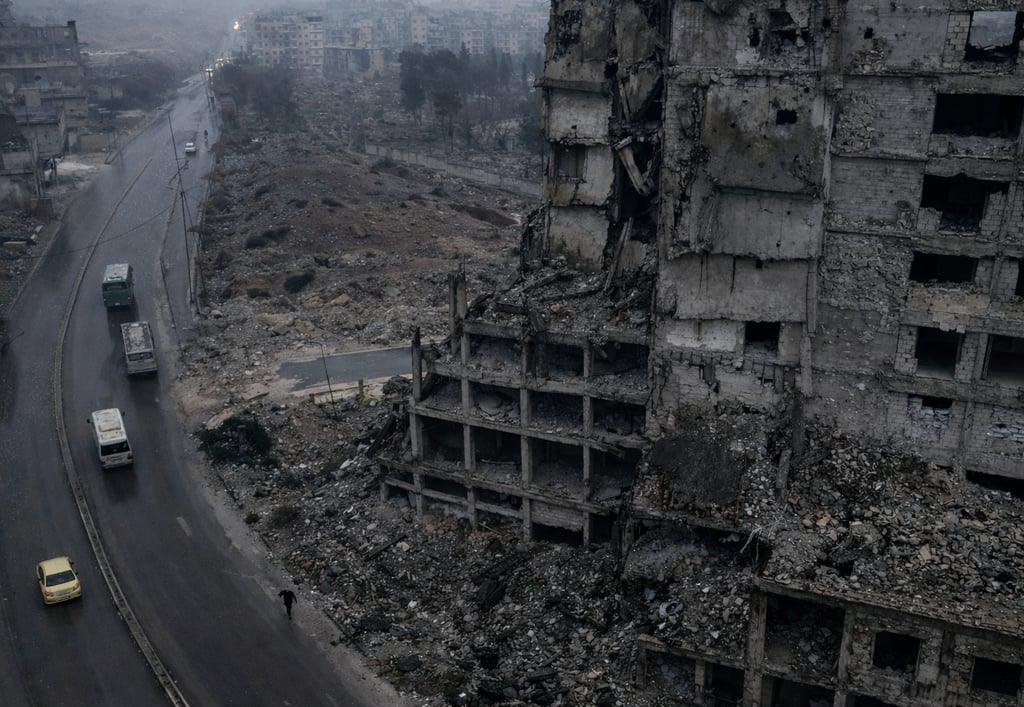
Syrian Army Secures Strategic Town as Kurdish Forces Pull Back Amid Integration Standoff
Syrian government forces took full control of the strategic town of Deir Hafer in Aleppo governorate on Saturday after Kurdish-led Syrian Democratic Forces (SDF) announced a tactical withdrawal, marking a significant development in the ongoing tensions between Damascus and Kurdish authorities over the integration of autonomous regions into Syria's new governance structure.
The SDF withdrawal from Deir Hafer, located approximately 50 kilometers east of Aleppo, came after days of mounting military pressure from Syrian army units and intense artillery bombardment that prompted thousands of civilians to flee the area. The Syrian military had declared the region a closed military zone and issued evacuation deadlines to residents, creating a humanitarian crisis as more than 4,000 people abandoned their homes seeking safety in government-controlled territories.
Kurdish Commander Announces Strategic Retreat
Mazloum Abdi, the commander of the Syrian Democratic Forces who also goes by the name Mazloum Kobani, announced late Friday that SDF forces would withdraw from contested positions east of Aleppo in what he characterized as a goodwill gesture responding to appeals from international mediators and allied nations. Writing on social media platform X, Abdi stated that the withdrawal would commence at 7:00 AM local time on Saturday, with forces redeploying to positions east of the Euphrates River.
The SDF commander emphasized that the tactical retreat demonstrated his organization's commitment to implementing provisions of the March 10th integration agreement, a framework established last year that envisioned the incorporation of Kurdish-led autonomous administrations into Syria's national governmental structure. However, that agreement has remained largely unimplemented, with deadlines repeatedly missed and negotiations reaching an apparent impasse by late 2025.
Stalled Integration Talks Fuel Military Confrontation
The current crisis stems from fundamental disagreements over how to integrate the SDF's estimated 100,000 fighters into Syria's national armed forces under the authority of the Defense Ministry in Damascus. The March 2025 agreement, signed between interim President Ahmed al-Sharaa's administration and Kurdish representatives, had established an end-of-year deadline for completing this integration process, but substantive implementation never materialized.
President al-Sharaa, who leads Syria's transitional government following the dramatic ouster of longtime ruler Bashar al-Assad in late 2024, has accused the SDF of taking no practical steps forward to fulfill the integration commitments. Speaking on state television earlier this week, al-Sharaa expressed hope that the agreement could still be implemented calmly, but warned that his administration's patience had limits as it seeks to reunify the fractured nation after nearly 14 years of devastating civil war.
The Kurdish leadership, meanwhile, has expressed deep skepticism about integration into an Islamist-led government structure, fearing the loss of the semi-autonomous zone they have governed for more than a decade. Kurdish representatives have pointed to concerns about their security, political representation, and cultural rights under a centralized Damascus administration, particularly given Turkey's ongoing hostility toward Kurdish political organizations.
Recent Aleppo Clashes Set Stage for Current Crisis
The deteriorating relationship between Damascus and Kurdish forces erupted into open violence earlier this month in Aleppo, previously Syria's largest city and economic hub. Several days of intense fighting in early January resulted in at least 23 deaths, according to Syria's Ministry of Health, as government forces moved to take control of Kurdish-held neighborhoods within the city proper.
The clashes began after integration talks collapsed, with Syrian troops ultimately seizing full control of the Sheikh Maqsoud and Ashrafieh districts, which Kurdish forces had governed since the early days of Syria's civil war beginning in 2011. More than 150,000 civilians fled these contested neighborhoods as fighting intensified, seeking refuge in government-controlled sections of Aleppo or attempting to reach other Kurdish-administered areas in northeastern Syria.
The SDF characterized its withdrawal from Aleppo neighborhoods as a partial ceasefire aimed at preventing further civilian casualties and facilitating the safe evacuation of wounded fighters and trapped residents. However, the retreat represented a significant strategic defeat for Kurdish forces and emboldened Damascus to press its advantage by targeting other SDF-held positions in the broader Aleppo governorate.
Massive Civilian Displacement Amid Military Escalation
Syrian authorities reported that at least 4,000 residents evacuated from Deir Hafer and surrounding villages on Friday after the army issued final deadlines for civilians to leave before launching operations against SDF positions. Local journalists reported scenes of families hastily packing belongings onto vehicles and fleeing eastward or toward government checkpoints, uncertain about their eventual destinations or when they might return home.
The transitional government in Damascus accused SDF forces of blocking civilian movement through humanitarian corridors established to facilitate safe passage from combat zones. Kurdish officials vehemently denied these allegations, instead blaming ongoing military escalation and indiscriminate shelling by Damascus-aligned factions for disrupting civilian evacuations and creating dangerous conditions for fleeing families.
Humanitarian organizations expressed alarm about the deteriorating situation, warning that renewed large-scale military operations could trigger another wave of displacement in a country where millions have already been uprooted by years of conflict. The United Nations and various aid agencies called on all parties to prioritize civilian protection and maintain humanitarian access to affected populations.
United States Caught Between Competing Allies
The escalating tensions placed Washington in an uncomfortable position, as the United States maintains positive working relationships with both the Syrian Democratic Forces and the new Syrian government under President al-Sharaa. American military officials made a high-profile visit to Deir Hafer on Friday, meeting with SDF commanders for over an hour in what appeared to be an eleventh-hour diplomatic intervention to prevent a major military confrontation.
U.S. special envoy Tom Barrack stated on Friday that Washington remains in close contact with all parties in Syria and is working tirelessly to de-escalate tensions, prevent further escalation, and facilitate a return to integration negotiations between the Syrian government and SDF leadership. A State Department spokesperson emphasized that both sides should refrain from actions that could push the country back into a destructive cycle of violence.
However, according to three diplomats and an SDF official who spoke to international media on condition of anonymity, the United States had not firmly opposed a limited Syrian military operation against Kurdish positions. Kurdish representatives expressed frustration with what they characterized as insufficient American efforts to prevent the confrontation, despite Washington's longstanding support for SDF forces during years of joint operations against the Islamic State terrorist organization.
The delicate American balancing act reflects Washington's attempt to recalibrate its Syria policy for a dramatically changed landscape. For years, the United States provided extensive military support, training, and equipment to the SDF as the primary ground force in the campaign to defeat ISIS's territorial caliphate. Now, Washington seeks to maintain those relationships while simultaneously building ties with al-Sharaa's transitional government, which it views as potentially offering the best hope for Syrian stability after decades of Assad family rule.
Historic Kurdish Rights Decree Offers Limited Concessions
In what appeared to be a carefully calibrated gesture toward Kurdish populations, President al-Sharaa issued a groundbreaking decree on Friday formally recognizing Kurdish as a national language and affirming that Syria's Kurdish minority constitutes an essential and integral part of the nation. The decree represents the first official governmental recognition of Kurdish rights since Syria achieved independence in 1946.
For decades, Syria's Kurdish population—estimated at approximately two to three million people, or roughly 10 to 15 percent of the national population—faced systematic marginalization, cultural suppression, and denial of citizenship rights under successive governments in Damascus. The Assad regime particularly targeted Kurdish political organizations and cultural institutions, viewing Kurdish nationalism as a threat to Syrian Arab identity and territorial integrity.
The timing of al-Sharaa's decree, issued as Syrian forces prepared to advance on Deir Hafer, suggested an effort to demonstrate goodwill toward ordinary Kurdish citizens while maintaining military pressure on SDF leadership. The decree received mixed reactions from Kurdish communities, with some viewing it as a meaningful step toward recognition and others dismissing it as inadequate tokenism that fails to address fundamental concerns about political autonomy and security guarantees.
Regional Powers Maneuver for Influence
The Syrian government's military operations against Kurdish positions occurred with at least tacit support from Turkey, which views the SDF as inextricably linked to the Kurdistan Workers' Party (PKK), a designated terrorist organization that has waged a decades-long insurgency seeking Kurdish autonomy in southeastern Turkey. Ankara has long demanded that Damascus sever any ties with Kurdish political movements and eliminate what Turkey characterizes as terrorist infrastructure near its southern border.
Turkish Foreign Minister Hakan Fidan stated publicly that the SDF must demonstrate good intentions by voluntarily withdrawing from Deir Hafer and other contested areas, rather than forcing Damascus to expel them through military operations. Turkey's position reflects Ankara's complex role as both a key supporter of Syria's new government and a determined opponent of any Kurdish political autonomy that might inspire similar movements among Turkey's substantial Kurdish minority.
Meanwhile, other regional powers watched developments carefully, assessing implications for their own interests in Syria's future. Iran, which maintained deep involvement in Syria throughout the civil war period supporting the Assad regime, has largely stepped back under the new government but retains concern about regional influence. Arab Gulf states, particularly the United Arab Emirates and Saudi Arabia, have signaled interest in supporting Syria's reconstruction and reintegration into regional frameworks, contingent on stability and governance reforms.
Oil Resources Complicate Integration Negotiations
Beyond the immediate military confrontation in Aleppo governorate, fundamental economic issues further complicate integration discussions. Kurdish-administered regions in northeastern Syria currently control significant oil fields that Damascus insists must fall under central government authority as part of any reunification agreement. These energy resources represent crucial potential revenue for both Syria's desperately needed reconstruction efforts and for funding services in Kurdish-administered areas.
According to Syrian army commanders who spoke to international media, additional government forces have been quietly deployed to remote areas of Deir el-Zor province, where Kurdish forces maintain control over critical oil infrastructure. This military positioning suggests Damascus may be preparing a broader campaign to reassert control over natural resources throughout northeastern Syria, potentially escalating beyond the current focus on Aleppo governorate.
SDF representatives have indicated willingness to negotiate resource-sharing arrangements, but insist on maintaining substantial autonomy over administration of Kurdish-majority regions and guaranteed political representation in national governance structures. These demands clash with Damascus's vision of a strongly centralized state under unified command, creating seemingly irreconcilable positions that diplomats describe as the fundamental obstacle to breakthrough in integration talks.
Uncertain Path Forward for Syrian Reunification
As Syrian government forces consolidated control over Deir Hafer on Saturday, the broader question of how to integrate Kurdish-administered regions into a reunified Syrian state remained unresolved. Military pressure may secure tactical victories and expand Damascus's territorial control, but fundamental political questions about minority rights, decentralization, and power-sharing continue to defy easy solutions.
International observers warned that a full-scale military campaign to forcibly integrate Kurdish regions could trigger prolonged conflict, massive displacement, and potential intervention by external powers with competing interests. The humanitarian toll of such escalation would fall primarily on civilian populations who have already endured over a decade of war, destruction, and instability.
For Syria's estimated two to three million Kurdish citizens, the coming weeks and months will prove critical in determining whether they can achieve meaningful recognition, rights, and security within a unified Syrian state, or whether the dream of peaceful coexistence will give way to renewed conflict. The international community faces difficult decisions about how to support Syrian reunification efforts while protecting minority populations and preventing the resurgence of extremist organizations that might exploit renewed instability.
Updates
Delivering timely news and inspiring life stories.
Links
Contact
+917976343438
© 2025. All rights reserved.