
Venezuelan Opposition Leader María Corina Machado Presents Nobel Peace Prize Medal to Trump Despite Committee Warning
María Corina Machado gave her 2025 Nobel Peace Prize medal to President Trump at White House meeting, though Nobel Committee says award cannot be transferred.
INTERNATIONAL POLITICS & DIPLOMACY
Sandeep Gawdiya
1/17/20267 min read
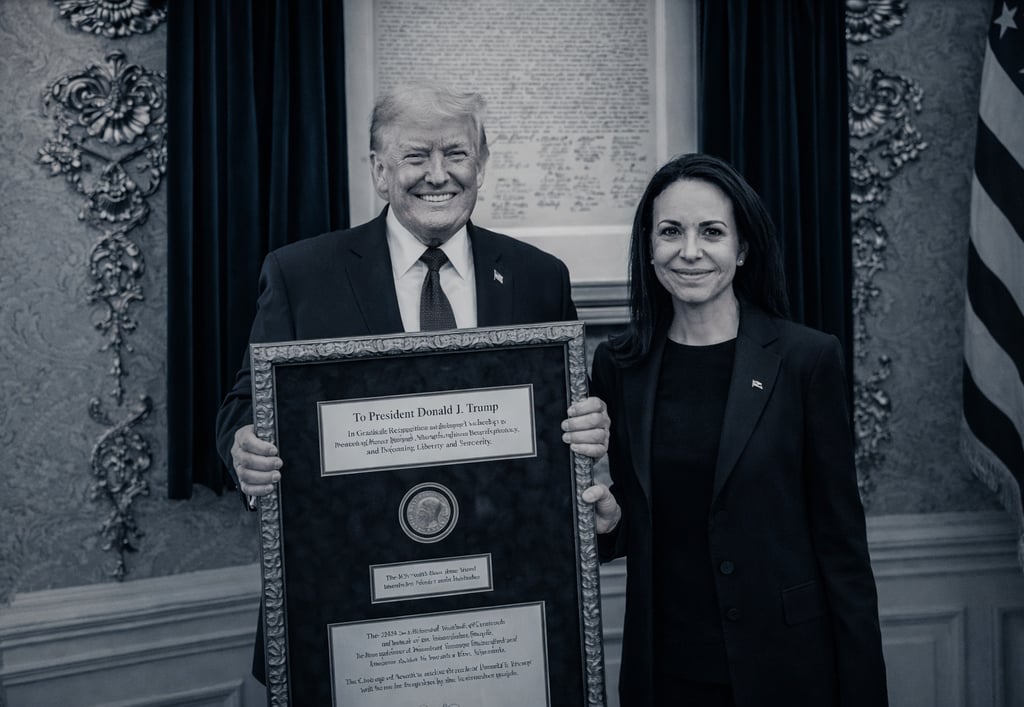
Venezuelan opposition leader María Corina Machado presented her Nobel Peace Prize medal to United States President Donald Trump during a private White House meeting on Thursday, in a controversial gesture that has reignited debates about Trump's relationship with authoritarian regimes and sparked immediate rebuke from the Norwegian Nobel Committee. The unprecedented move comes as Trump navigates competing Venezuelan factions following the recent U.S. military capture of former President Nicolás Maduro, while simultaneously pursuing American economic interests in the oil-rich nation.
Machado, who received the 2025 Nobel Peace Prize in October for her decades-long struggle against Venezuela's authoritarian government, told reporters outside the White House that she presented the medal to Trump "as a recognition for his unique commitment to our freedom." Trump, who has long coveted the Nobel Peace Prize and frequently claims he deserves the honor, accepted the medal and later posted on social media that it represented "a wonderful gesture of mutual respect".
Nobel Committee Issues Swift Clarification
The Norwegian Nobel Committee responded immediately to news of the medal transfer with an unequivocal statement emphasizing that Nobel Prizes cannot be shared, transferred, or revoked. "Once a Nobel Prize is announced, it cannot be revoked, shared or transferred to others," the committee declared. "The decision is final and stands for all time." Despite this clarification, Trump indicated through a White House spokesperson that he intends to keep the medal.
The White House released a photograph showing Trump holding a large golden frame containing Machado's medal alongside the Venezuelan opposition leader. The image quickly circulated on social media, drawing both praise from Trump supporters who view him as a champion of democracy and criticism from those who question his commitment to democratic principles and note his administration's simultaneous dealings with Maduro's former vice president.
The complete Nobel Peace Prize honor includes not only the distinctive gold medal but also a diploma and a monetary award of 11 million Swedish crowns, approximately $1.19 million. It remains unclear whether Machado also presented the monetary component to Trump or retained it for her opposition movement's activities.
Historical Context and Symbolic Significance
During the White House ceremony, Machado framed her gesture in historical terms, invoking the shared legacy of revolutionary leaders Simón Bolívar and George Washington. "The bond between our country and the United States in our shared struggle for freedom against oppression," she stated, adding that "200 years later, the people of Bolívar are returning a medal to the heir of Washington—in this instance, a Nobel Peace Prize medal—as a tribute to his unique commitment to our freedom".
This rhetorical flourish reflects Machado's strategic positioning as she attempts to secure Trump's endorsement as Venezuela's legitimate democratic leader following the controversial 2024 Venezuelan elections. According to ballot audits conducted by The Washington Post and independent monitors, opposition candidate Edmundo González received more than two-thirds of votes in the July 2024 election, though the Maduro-led government refused to disclose official precinct-level results. Machado's team, assisted by volunteers at polling sites, collected original voting receipts from over 80% of voting machines documenting the opposition's landslide victory.
Trump's Complicated Venezuela Policy
The medal presentation occurs against the backdrop of dramatically shifting U.S. policy toward Venezuela following the January 3 military operation that resulted in Maduro's capture in Caracas and his subsequent court appearance in New York on drug trafficking charges. However, rather than immediately endorsing Machado—who was widely viewed as her nation's prospective democratic leader—Trump has instead engaged with Delcy Rodríguez, Maduro's former vice president who now serves as Venezuela's acting head of state.
Trump and Rodríguez held a telephone conversation on Wednesday, marking their first known direct interaction despite their past hostile exchanges. Both parties commented positively on the discussion, with Trump's administration suggesting that Rodríguez appears willing to adopt a U.S.-friendly approach while maintaining elements of the current regime structure. This pragmatic approach has disappointed democracy advocates who hoped Maduro's removal would immediately usher in free elections and opposition leadership.
White House Press Secretary Karoline Leavitt stated that the president remains committed to transitioning Venezuela to democratic government and hopes to see elections conducted eventually, though no specific timeline has been established. Trump has also emphasized his desire to secure U.S. corporate access to Venezuela's substantial oil reserves, suggesting that economic considerations significantly influence his administration's approach to the country's political transition.
Machado's Strategic Gambit
For Machado, the Nobel medal presentation represents a calculated political maneuver designed to recapture Trump's attention and support at a critical juncture. The 58-year-old opposition leader, who has spent much of the past year in hiding due to threats against her safety, traveled to Washington seeking to restore her influence in ongoing discussions about Venezuela's future.
Prior to her White House visit, Machado had signaled her intention to share the Nobel Prize with Trump, stating publicly that "the Venezuelan people certainly want to give it to him or share it with him." Trump initially responded cautiously, telling Reuters: "No, I didn't say that. She won the Nobel Peace Prize." However, he subsequently acknowledged it would be "a great honor" if she chose to present him with the award.
Earlier in the week, Machado also secured an audience with Pope Leo XIV at the Vatican, where the pontiff expressed significant concern regarding Venezuela's political situation. This high-level diplomatic engagement demonstrates Machado's efforts to build international support for her movement's democratic aspirations.
Freddy Guevara, co-founder of the Venezuelan opposition party Voluntad Popular and a former political prisoner under Maduro now living in exile, told the BBC that he believes Machado's medal presentation was not motivated by personal ambition or a strategy to secure Trump's explicit endorsement. "I believe this is not a personal ambition. María Corina Machado recognizes the significance of this gesture, and she believes it is the right move for Venezuela's freedom," Guevara stated.
Trump's Long-Standing Nobel Aspirations
Trump's acceptance of Machado's medal reflects his well-documented desire to receive a Nobel Peace Prize—an ambition he has discussed publicly throughout his political career. The president frequently claims to have "ended eight wars" and has expressed frustration that the Nobel Committee has not recognized his diplomatic achievements, particularly regarding his engagement with North Korea and his role in Middle Eastern peace initiatives.
When asked why he would accept someone else's Nobel Prize medal, Trump justified the gesture by stating: "Well, she offered it to me. I thought it was very nice. She said, you know, you have ended eight wars, and nobody deserves this prize more than—in history—than you do. And I thought it was a very nice gesture." He concluded with characteristic praise for Machado, calling her a "very fine woman".
Trump's administration expressed disappointment when the Nobel Committee awarded the 2025 Peace Prize to Machado rather than the president. A White House representative remarked that the "Nobel Committee demonstrated a preference for politics over peace," suggesting the administration viewed Trump as more deserving of the honor.
During a congratulatory phone call following Machado's Nobel announcement in October 2025, she told Trump "how thankful the Venezuelan populace is for his endeavors, not just in the Americas, but worldwide, advocating for peace, freedom, and democracy." Nominations for the 2026 Nobel Peace Prize closed in January, coinciding with the commencement of Trump's second presidential term, raising speculation about whether he might be considered for future awards.
The 2025 Nobel Peace Prize and Machado's Recognition
The Norwegian Nobel Committee awarded Machado the 2025 Nobel Peace Prize for what they described as "one of the most remarkable examples of civilian bravery in Latin America in recent history." Committee chair Jørgen Watne Frydnes emphasized that Machado's recognition stemmed from "her efforts to secure a fair and peaceful transition from dictatorship to democracy" in Venezuela.
The committee particularly highlighted Machado's decision to remain in Venezuela despite extraordinary threats to her personal safety—a commitment that has inspired millions of Venezuelans and garnered international admiration. Throughout her career, Machado has led opposition campaigns, organized mass protests, and worked tirelessly to document electoral fraud and human rights abuses under the Maduro regime.
Following her Nobel recognition, Machado expressed gratitude for Trump's role in bringing international attention to Venezuela's democratic struggle. "We're grateful for what Trump is doing for peace," she stated in October, noting his efforts "around the world for peace, freedom, and democracy".
Reactions and Implications
The medal presentation has generated mixed reactions across the political spectrum. Trump supporters view the gesture as validation of the president's foreign policy achievements and his role in pressuring authoritarian regimes. They point to the U.S. military operation that resulted in Maduro's capture as evidence of Trump's commitment to democracy in Latin America.
Critics, however, question the appropriateness of accepting a Nobel Peace Prize medal—even symbolically—while simultaneously negotiating with Maduro's former vice president rather than supporting the democratically-elected opposition. They argue that Trump's pragmatic engagement with Rodríguez undermines democratic principles and suggests that U.S. policy prioritizes economic access to Venezuelan oil over genuine commitment to democratic transition.
The Norwegian Nobel Committee's insistence that prizes cannot be transferred raises questions about the legitimacy and meaning of Machado's gesture. While Trump physically possesses the medal, the Nobel Prize records will permanently identify Machado as the 2025 laureate, and no transfer of official recognition has occurred or can occur under Nobel rules.
For Venezuela's opposition movement, the incident highlights the complex challenge of navigating U.S. policy in pursuit of democratic change. Machado's willingness to present her most prestigious international recognition to Trump demonstrates the lengths opposition leaders feel compelled to go to secure American support—even as that support remains conditional and uncertain.
Looking Ahead: Venezuela's Uncertain Future
As Machado returned to her supporters outside the White House following the meeting, she told them in Spanish: "We can count on President Trump." However, the absence of any concrete commitment from Trump regarding Venezuela's political future leaves significant uncertainty about the path forward.
The fundamental question remains: Will Trump prioritize supporting Venezuela's democratic opposition and honoring the apparent will of Venezuelan voters, or will he opt for pragmatic engagement with existing power structures that promise stability and economic cooperation? The answer to this question will likely determine not only Venezuela's political trajectory but also the credibility of U.S. commitments to democracy promotion in Latin America.
For now, Trump's Nobel Prize medal—borrowed from Venezuela's opposition leader in a gesture that violated Nobel protocol but captured global attention—sits in the White House as a tangible reminder of the complex interplay between symbolism, power, and democratic aspirations in contemporary geopolitics.
Updates
Delivering timely news and inspiring life stories.
Links
Contact
+917976343438
© 2025. All rights reserved.