
Wimbledon Expansion Faces High Court Battle Over 150-Year-Old Statutory Trust as £200 Million Development Plans Challenged
All England Club's £200M expansion to add 39 courts faces critical High Court hearing today as Save Wimbledon Park argues 150-year-old law protects land for public recreation.
SPORTS LAW & INFRASTRUCTURE DEVELOPMENT
Sandeep Gawdiya
1/16/20269 min read
Wimbledon Expansion Faces High Court Battle Over 150-Year-Old Statutory Trust as £200 Million Development Plans Challenged
The All England Lawn Tennis and Croquet Club's ambitious £200 million ($267.9 million) plan to transform tennis' most iconic venue faces a potentially decisive legal challenge that began in London's High Court on Friday, January 16, 2026, as campaign group Save Wimbledon Park argues that a 150-year-old statutory trust permanently protects the former golf course land earmarked for development for public recreation purposes. The hearing, scheduled to run through January 23, 2026, centers on complex legal questions dating back to Victorian-era legislation and 1960s local government reorganization that could ultimately determine whether Wimbledon's proposed expansion—which would triple the tournament's current footprint by adding 39 grass courts and an 8,000-seat stadium—can proceed at all.
The Stakes: A "Potentially Decisive Case" for Wimbledon's Future
According to multiple outlets including the BBC, Al Jazeera, Reuters, and The Straits Times, the statutory trust case represents one of three parallel legal challenges Save Wimbledon Park (SWP) is pursuing against the tennis club's development plans—what the campaign describes as "triple jeopardy" for the project. However, this particular hearing carries exceptional weight because, as reported by Putney News and Local Government Lawyer, the All England Club has already conceded that if the statutory trust is found to apply to the land, the proposed development cannot proceed.
"The tennis club has previously conceded that if the statutory trust is found to cover the land, the proposed development cannot proceed, making this case potentially decisive," Putney News reported on January 9, 2026, citing communications from Save Wimbledon Park to supporters ahead of the hearing. The AELTC's own acknowledgment of this legal vulnerability underscores the existential nature of the challenge to expansion plans that have been in development for years and received planning approval from the Greater London Authority in September 2024.
The 73-acre site at the center of the dispute is the former Wimbledon Park Golf Club, which the All England Club purchased in stages, ultimately acquiring the freehold in 1993. According to the BBC and Yahoo News UK, the club's £200 million development proposal would construct 38 new grass tennis courts (some outlets report 39 courts) and an 8,000-capacity stadium on this land, which is partially designed by renowned 18th-century landscape architect Lancelot "Capability" Brown and holds Grade II* listed heritage status.
The Central Legal Question: Does a Statutory Trust Protect the Land?
As reported by the BBC, Al Jazeera, and Local Government Lawyer, the core legal question before Justice David Foxton in the High Court concerns whether the land remains subject to a Section 164 statutory trust for public recreation—a legal mechanism established under the Public Health Act 1875 and potentially imposed when London local authorities were reorganized in the 1960s.
According to Local Government Lawyer, citing court filings, Save Wimbledon Park argues that the statutory trust was created when the land was transferred during the 1960s local government reorganization that established modern London boroughs. The campaign group contends this trust survived even when the All England Club acquired the freehold of the golf course land from Merton Council in 1993, because—crucially—there was no notice of a Section 164 statutory trust registered on the property title at that time.
"SWP meanwhile is set to argue in the High Court that the development site remains subject to a public recreation trust, notwithstanding the fact that the land had previously been leased to a private golf club," Local Government Lawyer reported on January 13, 2026. This argument suggests that even though the land functioned as an exclusive private golf club for over a century, the underlying legal obligation for public recreational access never disappeared.
Yahoo News UK reported from the court hearing on January 16 that Save Wimbledon Park's legal representatives contended "this trust was established when the land was transferred in the 1960s and persisted when the club acquired the freehold in 1993." The BBC similarly reported that campaigners argue the 150-year-old legislation "may restrict how land earmarked for the expansion of the Wimbledon tennis site can be used."
The All England Club's Counter-Arguments
Attorneys for the All England Lawn Tennis and Croquet Club, as reported by Yahoo News UK, The Straits Times, and the BBC, argue that the land has never been subject to such a statutory trust and, even if it had been at some point, the trust would not have survived the 1993 freehold purchase. Jonathan Karas KC, representing the club, stated in written submissions cited by Yahoo News UK that it would be "anomalous" for the land to be bound by a trust, emphasizing that "the golf course has consistently been regarded as private property leased to a private club, and it was sold to the All England Club under that premise."
The Straits Times reported that the AELTC's lawyers argue "the land is not subject to such a trust" and "has never been used for public recreation"—a factual claim that addresses the Victorian-era legislation's requirement that protected lands serve public recreational purposes. The club's position, as stated on its website and cited by Arch Paper, is unequivocal: "Our position was and remains that there is not, nor has there ever been, a statutory trust affecting the former Wimbledon Park Golf Course land."
According to Local Government Lawyer, the All England Club advances two primary legal arguments on the trust question. First, that no statutory trust was ever imposed on this particular land during the 1960s reorganization. Second, even if such a trust had been created, it did not survive when Merton Council sold the freehold to the AELTC in 1993 because there was no notice of a Section 164 statutory trust registered on the property title—meaning subsequent purchasers had no legal notice of any such restriction.
The BBC reported that the club "acknowledges that if a trust were to be recognized, it would impede its development ambitions," while simultaneously maintaining its confidence that no such trust exists or, if it once did, no longer applies to the property.
A Four-Year Legal Battle With Multiple Fronts
As reported by Putney News and the BBC, the January 2026 statutory trust hearing represents the latest chapter in a multi-year legal struggle that has seen the campaign group pursue three distinct legal challenges against the expansion project. In July 2025, Save Wimbledon Park lost its initial judicial review in the High Court, where it challenged the Greater London Authority's September 2024 decision to grant planning permission for the development.
According to the BBC and Putney News, Justice Pushpinder Saini rejected SWP's arguments that the GLA had failed to properly account for the statutory trust and restrictive covenants when approving the plans. However, the BBC and Al Jazeera reported that in November 2025, the Court of Appeal granted Save Wimbledon Park permission to appeal that ruling, with Lord Justice Holgate stating the grounds were "arguable with a real prospect of success," according to court documents cited by the Community and Justice Action Group (CJAG). That appeal hearing has not yet been scheduled but is expected to occur later in 2026.
The statutory trust case represents the second major legal front. Unlike the judicial review, which challenged the planning authority's decision-making process, this case addresses the fundamental legal status of the land itself. As Arch Paper reported in July 2025, following the initial judicial review defeat, the AELTC itself requested this hearing "to establish that there is no trust over the land" and resolve the question definitively.
Putney News reported that Save Wimbledon Park characterizes this multi-front legal strategy as creating "triple jeopardy" for the tennis club's development, with the campaign pursuing the judicial review appeal, the statutory trust case, and a third challenge related to restrictive covenants on the property.
Political Controversy: Failed Attempt to Retroactively Change the Law
The legal battle took a controversial political turn in late 2025 when, according to Putney News and CJAG, a member of the House of Lords attempted to insert Amendment 250 into legislation that would have retrospectively removed statutory trust protections from the Wimbledon site. The amendment was ultimately abandoned after peers from across the political spectrum condemned it as an inappropriate erosion of green space protections and an improper interference in ongoing legal proceedings.
"The legal battle also took a controversial turn when a member of the House of Lords attempted to retrospectively change the law to remove the statutory trust protections. Amendment 250 was abandoned after peers from across the political spectrum condemned it as an erosion of green space protection," Putney News reported. CJAG similarly noted that "a Lords amendment aimed at clearing the way for Wimbledon's expansion has fallen, leaving the project exposed to renewed legal challenges."
This legislative intervention attempt and its subsequent failure underscores the high stakes and political sensitivity surrounding the case, which pits the interests of one of Britain's most prestigious sporting institutions against environmental campaigners and local residents concerned about the loss of green space and public access to historic parkland.
Community Mobilization and "David vs. Goliath" Framing
Save Wimbledon Park has actively mobilized public support for its legal challenges, framing the battle as a "David and Goliath struggle" against the well-resourced tennis club. According to Putney News, the campaign called on supporters to attend the opening day of the January 16 hearing to provide visible public backing and attract media attention.
"We would like to make some noise on the 16th for the benefit of journalists and (we hope) TV crews, so we need our supporters to come along," Save Wimbledon Park coordinator Simon Wright wrote to supporters on January 14, as quoted by Putney News. The campaign has successfully raised over £200,000 through crowdfunding platforms to finance its legal challenges, according to CrowdJustice campaign pages and multiple media reports.
Christopher Coombe, director of Save Wimbledon Park, stated following the November 2025 Court of Appeal decision granting permission to appeal: "SWP has never been steam-rollered. We think it is time for the AELTC to acknowledge the numerous legal and principled issues with its proposals and engage in constructive dialogue with SWP and the local community," as reported by the BBC.
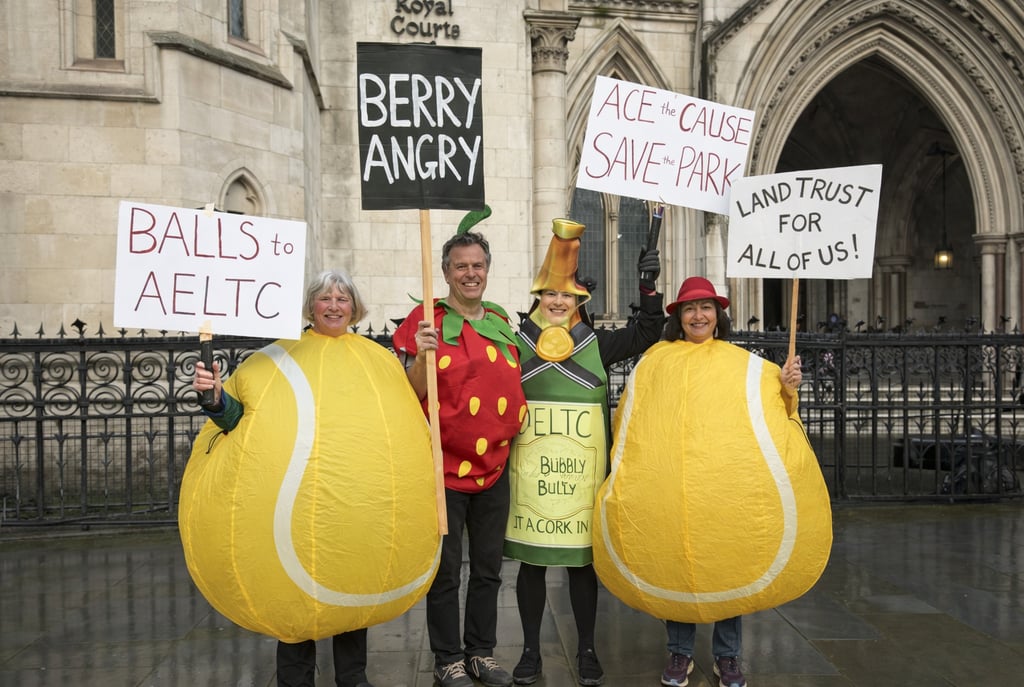
Reuters reported that protesters, including at least one activist dressed in a strawberry costume from the organization Save Wimbledon Park, gathered outside the courts holding placards reading "Berry Angry" as the January 16 hearing commenced—a reference to Wimbledon's famous association with strawberries and cream.
Broader Implications for Protected Green Spaces
Beyond the immediate question of Wimbledon's expansion, legal observers suggest the case could establish important precedents for the protection of historic parkland and green spaces across England. Following the initial July 2025 judicial review defeat, Save Wimbledon Park director Christopher Coombe warned that the ruling, "if upheld, would create a concerning precedent for the unwanted development of protected green belts and public open spaces throughout London and the rest of the country," according to the BBC's July 2025 reporting.
The case involves complex intersections of planning law, property law, Victorian-era public health legislation, and 20th-century local government reorganization—legal complexities that may have implications far beyond a single sporting venue. The question of whether statutory trusts created during 1960s local government reorganizations survived subsequent property sales could potentially affect numerous other sites across London and England where similar historical circumstances exist.
What Happens Next: A Months-Long Wait for Judgment
According to the Wimbledon Society and Putney News, the High Court hearing is scheduled to run from January 16 through January 23, 2026—a six-day hearing reflecting the complexity of the legal and historical questions at stake. However, as the Wimbledon Society noted on January 14, "The judgement is not expected for 2-3 months," meaning a decision likely won't be issued until March or April 2026 at the earliest.
Even after Justice Foxton issues his ruling on the statutory trust question, further legal proceedings are expected. The Court of Appeal hearing on the separate judicial review challenge to the GLA's planning approval has been granted but not yet scheduled. Additionally, questions remain about restrictive covenants on the property that form part of Save Wimbledon Park's broader legal strategy.
Al Jazeera reported that the All England Club "plans to treble the size of the existing site in London, adding 39 courts," while Reuters noted the project would "introduce 39 new tennis courts" to what has hosted the Championships since 1877. The development is intended to provide a permanent home for Wimbledon's qualifying rounds and expand the tournament's capacity, but whether those plans can proceed now depends on centuries-old legal protections and their interpretation by 21st-century courts.
Deborah Jevans, chair of the All England Club, expressed "delight" at the July 2025 judicial review ruling, according to the BBC, stating that the expansion would "cement Wimbledon's reputation as the greatest competition in the world" and provide public access to land that "has been a private golf course for over a century." London Mayor Sadiq Khan similarly welcomed that ruling as "good news."
However, Save Wimbledon Park and its supporters maintain that the historic parkland, designed in part by one of England's most celebrated landscape architects, should be preserved for genuine public recreation rather than developed into additional facilities for an already world-class tournament venue.
As the six-day hearing unfolds in London's Royal Courts of Justice, the outcome will determine not only the physical future of one of tennis' most hallowed grounds but also establish important legal precedents about the durability of Victorian-era public protections and the balance between sporting ambition and heritage conservation in 21st-century Britain.
Updates
Delivering timely news and inspiring life stories.
Links
Contact
+917976343438
© 2025. All rights reserved.